

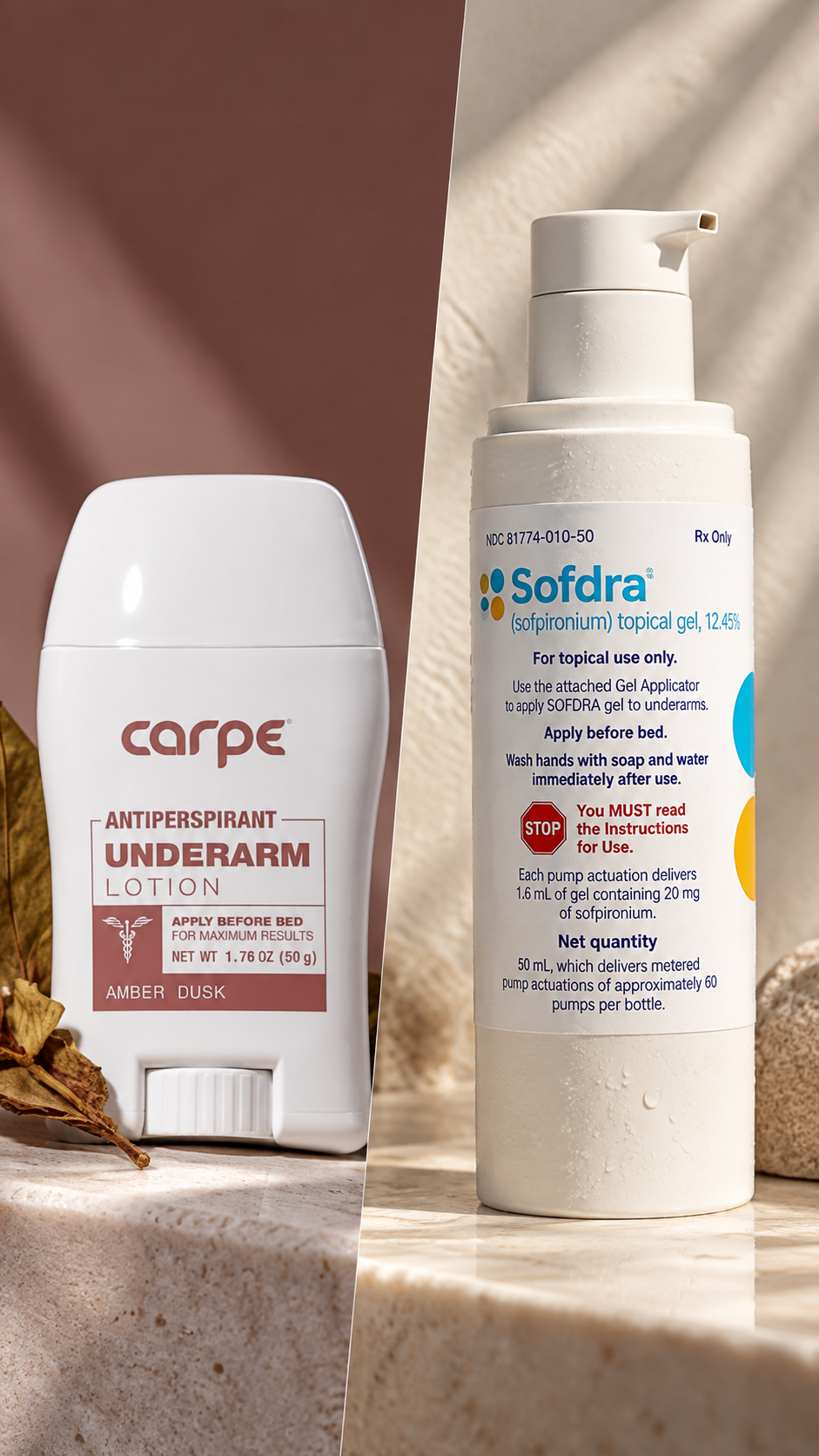
If you're stuck choosing between Carpe and Sofdra, the decision comes down to more than just what works. It's about where you sweat, how severe it is, and what you're willing to deal with to get access. A closer look at how these two compare makes the right call a lot clearer.
TLDR:
- Carpe uses aluminum salts to physically plug sweat ducts; Sofdra blocks the nerve signal that tells glands to sweat at all
- Carpe covers many body zones but only Sofdra targets the nerve signal, and it treats underarms only
- OTC aluminum chloride gave adequate relief to only about 15% of patients in Patra et al. (2020), so diagnosed hyperhidrosis often needs more
- Sofdra without insurance runs roughly $970 to $1,448 per tube; Carpe products range from about $20 to $48 with no prescription needed
- Twofold makes prescription treatments accessible for multiple body zones with follow-up dermatologist care included
What Is Carpe?
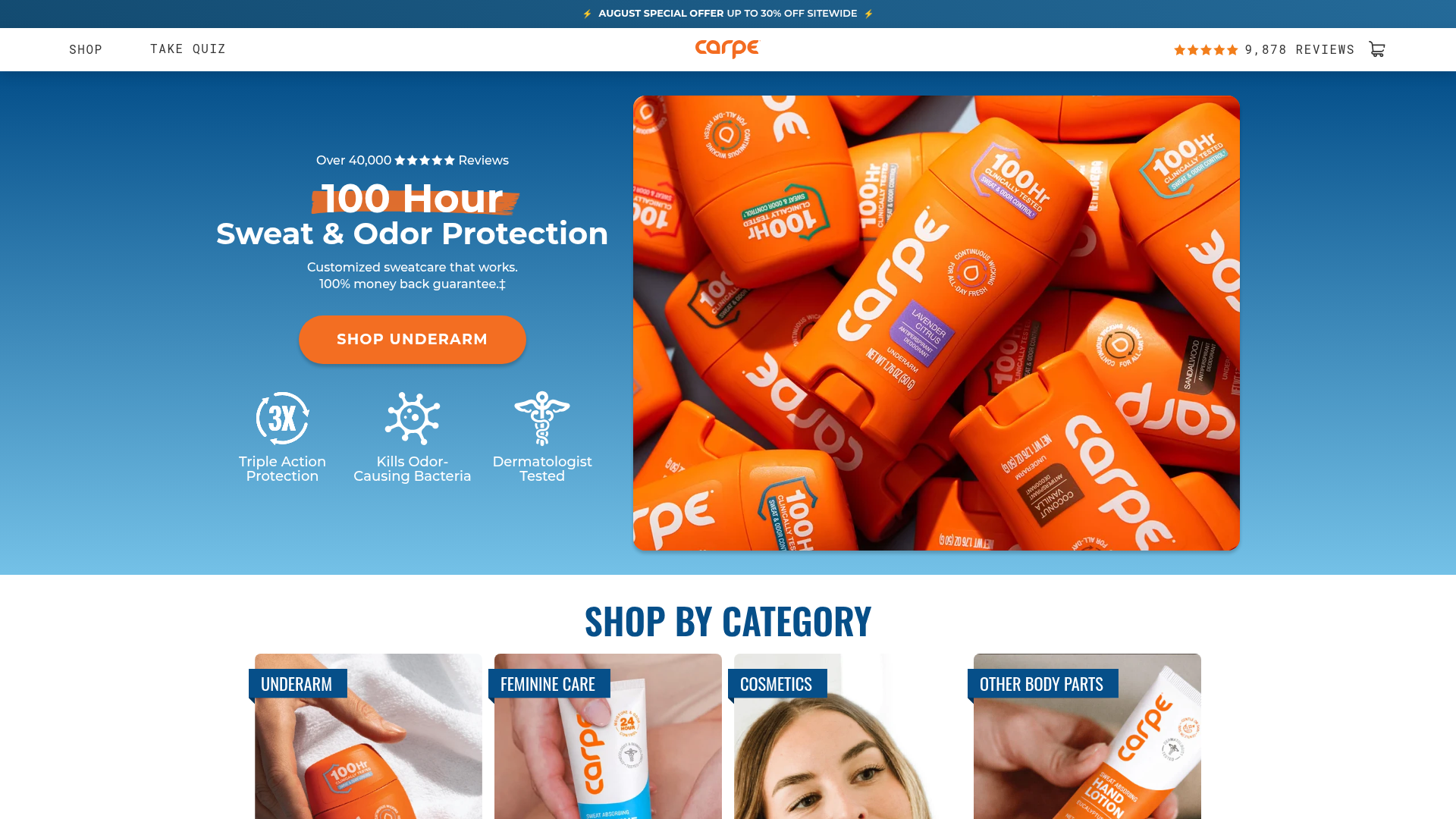
Carpe is a direct-to-consumer brand selling over-the-counter antiperspirant and sweat-absorbing products built to combat both everyday sweating and hyperhidrosis. Its active ingredients are aluminum salts, which physically plug sweat ducts near the skin's surface.
The lineup is wide. It spans:
- Antiperspirant underarm sticks
- Hand and foot lotions
- Face wipes
- Breast lotion
- Groin and thigh products
- A 3-step underarm regimen
There's no prescription, no doctor involvement, and no clinical intake. You pick a product, buy it, and manage things yourself. Carpe sits at the OTC tier, built for people who want accessible, low-barrier sweat control across many body zones.
What Is Sofdra?
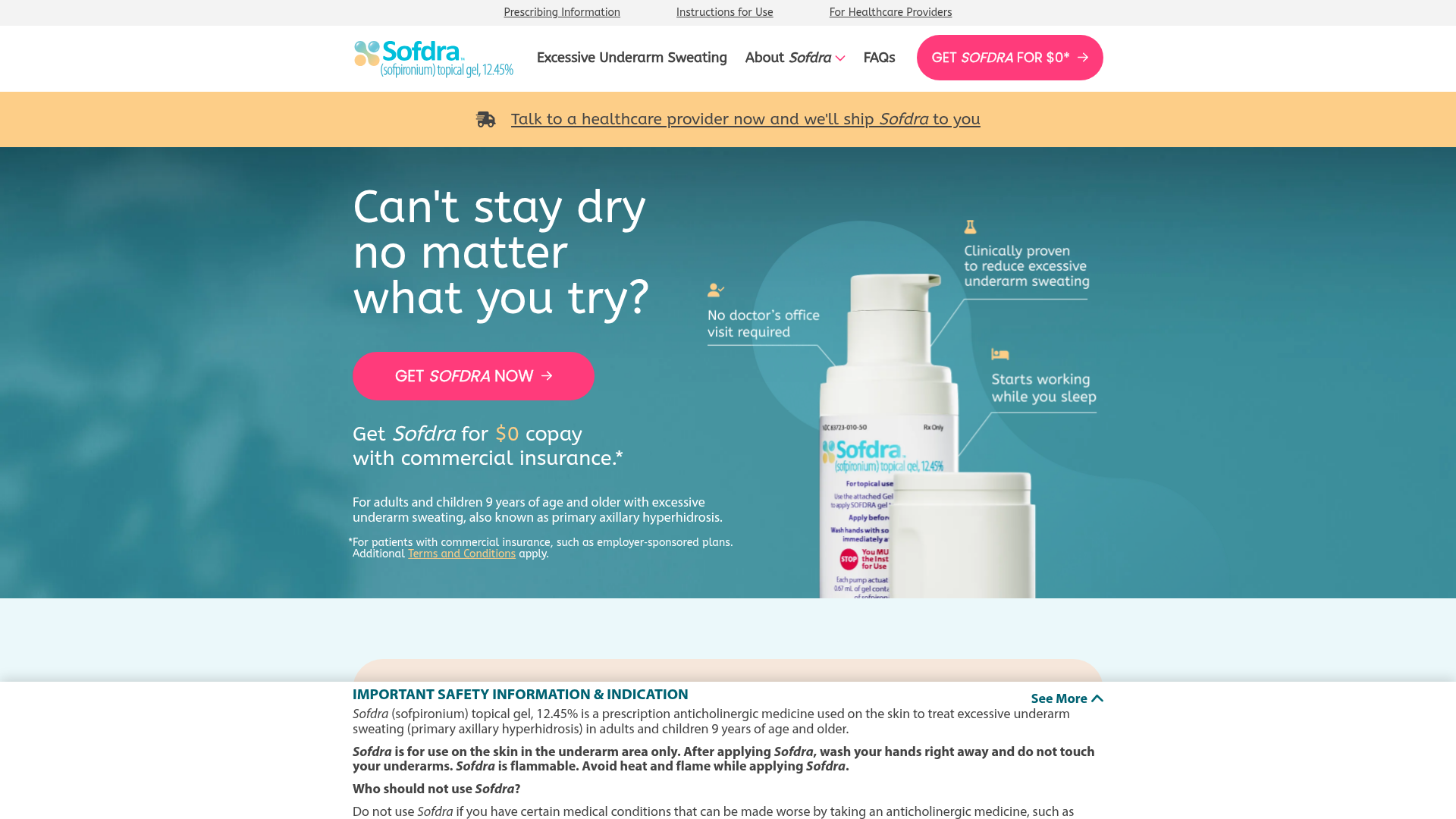
Sofdra is a prescription gel the FDA approved in June 2024 to treat primary axillary hyperhidrosis, meaning underarm sweating, in adults and children ages 9 and up. Made by Botanix Pharmaceuticals, its active ingredient is sofpironium, an anticholinergic that blocks sweating at the source. It's the first at-home, self-applied hyperhidrosis treatment to earn FDA approval since 2018.
A few things define how you actually get it:
- It treats one zone: the underarms
- Access runs through a dedicated telehealth portal with a scheduled video visit
- Its pitch leans on a "$0 copay" offer for commercially insured patients
Insurers typically require prior authorization before covering it.
| Carpe | Sofdra | |
|---|---|---|
| Type | OTC antiperspirant | Prescription gel (FDA-approved June 2024) |
| Active ingredient | Aluminum salts | Sofpironium (anticholinergic) |
| Mechanism | Plugs sweat ducts near skin surface | Blocks nerve signal that triggers sweating |
| Body zones covered | Underarms, hands, feet, face, groin, breast, scalp | Underarms only |
| Prescription required | No | Yes: scheduled telehealth video visit (~$35) |
| Insurance / prior auth | Not needed | Prior authorization typically required |
| Cost without insurance | ~$20 to $48 per product | ~$970 to $1,448 per tube |
| Clinical evidence | ~15% adequate relief in diagnosed hyperhidrosis (Patra et al., 2020) | ~85% improvement in Phase 3 Cardigan I/II trials |
| Common side effects | Local skin irritation, burning, stinging. This is not a complete list of possible side effects. | Dry mouth, blurry vision, application-site irritation. This is not a complete list of possible side effects. |
| Ongoing clinical support | None; self-managed OTC purchase | Initial visit only; follow-up requires a new visit |
How Carpe and Sofdra Work Differently
The two products stop sweat in different ways, and the gap matters once OTC products stop cutting it.
Carpe works on the surface. Its aluminum salts dissolve on the skin and form plugs inside the sweat ducts, physically blocking sweat from reaching the surface. The gland keeps making sweat. The duct just gets corked.
Sofdra works upstream. Sofpironium is an anticholinergic, so it interrupts the nerve signal telling the gland to switch on. Less signal, less sweat.
That distinction is why people with moderate-to-severe hyperhidrosis often outgrow duct-plugging antiperspirants. Aluminum salts also carry an irritation trade-off, with burning and stinging common enough to force some users to quit, per a review in JCAD.
Body Zones Each Option Covers
Zone coverage is where these two differ most.
Carpe spreads across the body. It sells formats for underarms, hands, feet, face, groin, breast, and scalp, so on paper it reaches almost anywhere you sweat. The catch is mechanical: aluminum salts struggle on thicker-skinned areas like palms and soles, and irritation remains the core trade-off, as documented in JCAD.
Sofdra goes the other direction. Its FDA label and insurance criteria both restrict it to primary axillary hyperhidrosis, so it's meant for underarms and nowhere else. For palmar, plantar, or facial sweating, it isn't an option at all.
Prescription Access and What It Requires
Getting each product looks nothing alike once you move past the shopping cart.
Carpe asks nothing of you clinically. No intake, no visit, no gatekeeping. You buy it and start that day, which makes it one option when looking for an antiperspirant for sweat control.
Sofdra runs through a scheduled, paid telehealth video visit, typically a $35 fee, with an independent provider before any prescription is written. From there, most commercial insurers require prior authorization before the medication is dispensed.
Those extra steps trip up some patients, especially anyone on a government plan.
Cost Without Insurance
Price is where the split gets stark, especially if you're paying out of pocket.
Carpe stays cheap and open to anyone. Individual products run roughly $19.95 to $47.95, no insurance or prescription needed.
Sofdra is a different order of magnitude. Its typical retail price without insurance is about $1,447.97 per tube, though discount programs can bring that down to around $970.92 per tube.
The "$0 copay" offer only helps if you hold qualifying commercial insurance. If you're uninsured, underinsured, or on Medicare, Medicaid, or TRICARE, you're likely looking at that full retail figure.
Clinical Evidence and Efficacy Data
The evidence bases here sit at very different depths.
Sofdra has formal trial data. In pooled Phase 3 Cardigan I/II trials, about 85% of patients on sofpironium 12.45% showed real improvement on the HDSM-Ax underarm sweat measure versus vehicle, a statistically strong difference (p<0.0001).
Carpe's aluminum-based approach is well studied as a category, though results skew modest for diagnosed cases. Antiperspirants for excessive sweating vary widely in strength and formula. Prescription-strength antiperspirants may outperform OTC ones simply because they contain higher concentrations of active ingredient, per Patra et al. (2020). Stepwise data from Patra et al. (2020) found aluminum chloride alone gave adequate relief in only about 15% of patients, which helps explain why OTC options often fall short once hyperhidrosis is diagnosed.
Ongoing Support and Treatment Adjustments
What happens after you start matters, and both options leave that part thin.
Carpe is a one-off purchase. There's no provider watching, no way to adjust dose, and no built-in next step if a product isn't cutting it. When OTC strength stops working, you're left to figure it out on your own, hopping between formats or guessing at what to try next. Reducing excessive sweating covers lifestyle changes and prescription steps that can help when OTC options fall short.
Sofdra's telehealth model is built around the prescription itself. The initial video visit gets you the gel, but ongoing care beyond that isn't really defined. Another anticholinergic option worth comparing is glycopyrrolate for hyperhidrosis. Any meaningful change, like adjusting your plan, can mean a fresh visit and another prior authorization cycle before anything moves.
Commonly Reported Side Effects
Both options carry side effects, and they show up in different places.
Sofdra is an anticholinergic, so its concerns skew systemic. Commonly reported side effects include dry mouth, blurry vision, and irritation at the application site. This is not a complete list of possible side effects.
Carpe and other aluminum-based antiperspirants keep the concern local. The labeling tells users not to apply to broken or irritated skin and to stop use if a rash occurs. Again, this is not a complete list, including but not limited to what's noted here.
For personal health questions, talk to a provider before starting either.
Why Twofold Fills the Gaps Both Miss
Carpe reaches many zones but plugs ducts weakly. Sofdra works upstream but only on underarms. Twofold's compounded oxybutynin 8% gel bridges both gaps.
- Zone coverage: it's prescribed for hands, feet, face, underarms, back, chest, and groin, covering wherever you actually sweat.
- Mechanism: as an anticholinergic, it blocks the nerve signal like SOFDRA does. A 2024 systematic review found topical oxybutynin produced HDSS improvement in 73.6% of patients versus 42.8% on placebo.
- Access: $150 for a 3-month supply, no insurance and no prior authorization.
- Ongoing care: sweat-specialized dermatologists review your intake within about 24 hours, with unlimited follow-up messaging for dose adjustments or adding oral options when appropriate.
Its hyperhidrosis use is off-label and the compounded gel isn't separately FDA-approved. Results aren't guaranteed, so consult a provider.
Final Thoughts on Carpe vs. Sofdra
Carpe and Sofdra are built for different points on the sweating scale, so neither is the wrong answer in the right context. What matters most is matching the product to where and how much you sweat. If you're still unsure after reading, a quick conversation with a dermatologist can point you in the right direction.
FAQ
Is Carpe or Sofdra better for hyperhidrosis on the hands and feet?
Carpe has hand and foot formats, but aluminum salts may penetrate poorly on thicker skin, so relief limited. Sofdra is underarms only by its FDA label.
How does Sofdra's cost compare to Carpe without insurance?
Carpe products run roughly $19.95 to $47.95 per item with no prescription needed. Sofdra's retail price without qualifying commercial insurance sits around $970 to $1,448 per tube, and its "$0 copay" offer doesn't apply if you're uninsured or on a government plan like Medicare or Medicaid.
Do you need a doctor's visit to get Sofdra or Carpe?
Carpe requires no clinical visit at all; you buy it directly and start the same day. Sofdra requires a scheduled, paid telehealth video visit (typically $35) plus prior authorization from your insurer before the prescription is dispensed, which can slow things down considerably.
Is Sofdra more clinically proven than Carpe for moderate-to-severe hyperhidrosis?
Sofdra has formal Phase 3 trial data showing about 85% of patients saw real improvement in underarm sweating. Carpe's aluminum-based approach is well studied as a category, but stepwise data from Patra et al. (2020) found aluminum chloride alone gave adequate relief in only about 15% of patients with diagnosed hyperhidrosis, suggesting OTC antiperspirants often fall short once sweating becomes a clinical concern.
When should you consider moving beyond Carpe or Sofdra for hyperhidrosis treatment?
If Carpe's OTC strength has stopped working, or if your sweating affects zones other than your underarms (like your hands, feet, or face), Sofdra won't cover those areas either. A prescription anticholinergic option prescribed across multiple body zones with ongoing dermatologist support may be worth considering when both products leave gaps in your coverage or relief.
If you see a mistake or something you think should be updated, let us know at hello@itstwofold.com!


