

Searching for oxybutynin topical gel and ending up more confused than when you started? That's pretty common. Between the discontinued brand name, varying concentrations, and off-label use, there's a lot to sort through. Here's a straightforward look at what it is, what the research actually shows, and what you should know going in.
TLDR:
- Oxybutynin gel blocks the nerve signal that triggers sweating and tends to cause fewer side effects than the pill form
- A 2024 systematic review found 73.6% of patients improved on topical oxybutynin vs. 42.8% on placebo (p<0.00001; JAAD Reviews 2024 systematic review)
- Broader anticholinergic side effects like dry mouth appeared in fewer than 1% of participants in pooled studies (2024 JAAD Reviews systematic review)
- Twofold offers a compounded oxybutynin 8% gel designed for hands, feet, underarms, and other zones beyond just underarms
What Oxybutynin Topical Gel Is and How It Works
Oxybutynin belongs to a class of drugs called anticholinergics, sometimes labeled antimuscarinics. In plain terms, it blocks a messenger chemical your nerves use to switch on sweat production.
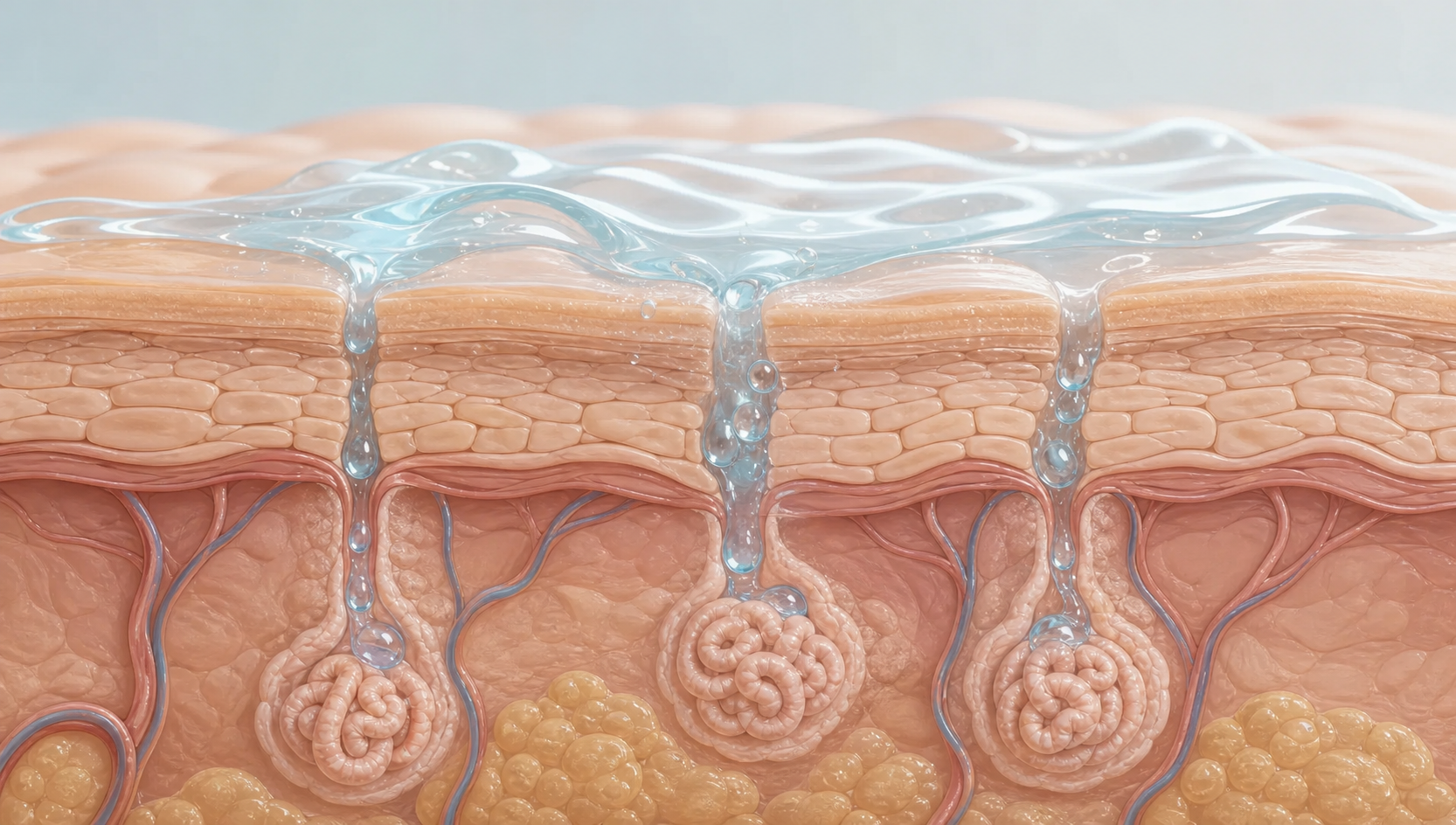
Sweat starts when acetylcholine binds to muscarinic M3 receptors on your eccrine glands (the sweat glands across your skin). Oxybutynin blocks that binding, quieting the signal that tells the gland to fire.
Why a gel form exists
Taken as a pill, oxybutynin passes through your gut and liver first, forming a metabolite thought to be behind many dry-mouth and drowsiness complaints. Rubbing it onto skin may sidestep some of that, which can mean fewer body-wide effects for many people (JAAD Reviews 2025).
Oxybutynin is FDA-approved for overactive bladder, so using it for sweating is off-label.
Oxybutynin Gel for Hyperhidrosis: What the Evidence Shows
So does it actually work? The data says yes, with caveats worth knowing.
A 2024 systematic review pooling topical oxybutynin trials found 73.6% of patients improved by at least one point on the hyperhidrosis severity and treatment overview scale (a four-point measure of how much sweating disrupts daily life), versus 42.8% on placebo, a gap that held up statistically (p<0.00001).
In one randomized, double-blind trial, 61 patients applied 10% gel to one side of the body and placebo to the other. The treated skin showed greater sweat reduction than the placebo side.
The caveat: most studies are small, and larger trials are underway.
Gelnique: What It Was and Why It Is No Longer Available
If you or your doctor once reached for Gelnique, here is where things stand.
Gelnique was the brand-name oxybutynin topical gel, sold as 10% single-dose sachets and later a 3% pump, made by Allergan and FDA-approved for overactive bladder. Some providers prescribed it off-label for sweating, though it was never formally indicated for hyperhidrosis.
Both the Gelnique brand and its pump version have since been discontinued in the U.S. So if you are searching whether it is still available, the short answer is no.
With the branded product gone, compounded oxybutynin gel is now the practical way to get this formulation, prepared fresh by a pharmacy to a prescriber's specifications.
Concentrations, Vehicles, and Formulation Differences
The variation trips people up. Search around and you will find oxybutynin described at 3%, 8%, 10%, even 20%, which raises the obvious question of which number is right.
Here is the short version: there is no single agreed standard yet. Trials have tested oxybutynin across a wide span of preparations and durations, from four weeks out to a full year.
| Preparation | Concentrations studied |
|---|---|
| Gel | 1%, 3%, 8%, 10% |
| Lotion | 20% |
| Cream | 10% |
| Nanoemulsion gel | Varies |
| Transdermal patch | Fixed-dose |
The vehicle (the base a drug is carried in) matters as much as the percentage. Palms and soles have thick skin, so a formula that penetrates well reaches the sweat glands better than one that sits on top. For context on how topical options compare to reducing excessive sweating with OTC products, the vehicle choice is just one piece of a broader puzzle.
How to Apply Oxybutynin Gel
Application matters as much as the medication itself. Get it wrong and you blunt the effect or trade sweat for irritated skin.
Start with clean, dry skin. Wash the area, pat it dry, and skip lotions or powders that could block absorption. Then keep a few things in mind:

- Rotating application sites when treating the same zone repeatedly is a common recommendation to spread out any irritation rather than concentrating it in one spot. Your prescriber can walk you through exactly how to do this for your situation, including if you are still working out how to stop sweating more broadly.
- Prescribers and pharmacists typically advise against applying to open wounds, broken skin, or freshly shaved areas. The alcohol base can cause stinging, and absorption may be harder to predict in those areas.
- Waiting at least an hour before bathing, swimming, or exercise is commonly recommended to give the gel time to absorb rather than wash off.
- The gel contains alcohol and stays flammable until fully dry. Your pharmacist can walk you through any specific precautions to take while it dries.
- Washing your hands right after applying is commonly recommended to reduce the chance of accidental transfer to other areas.
How many pumps you use, and how often, should come from your prescribing provider. Do not adjust the dose on your own.
Side Effects of Oxybutynin Topical Gel
In pooled studies, side effects were most often reported at the application site. The ones people report most are application site reactions, meaning local irritation, dryness, redness, or itching, followed by dry mouth and thirst in a small minority. Broader anticholinergic effects like headache, dry eyes, constipation, and blurred vision turned up in fewer than 1% of participants in the 2024 systematic review.
Why so much milder than the pill? Skin application skips the gut and liver first pass, cutting the metabolite behind most body-wide anticholinergic burden. Reduced, though, is not the same as gone. If effects bother you, contact your prescriber.
Risks, Warnings, and Who Should Avoid It
Some people should steer clear of oxybutynin entirely. It is contraindicated if you have urinary retention, uncontrolled narrow-angle glaucoma, or a serious gastrointestinal obstructive disorder, because the drug can worsen all three. This list is not exhaustive.
Others need close supervision:
- Liver or kidney disease, which changes how your body clears the medication
- Myasthenia gravis, a condition affecting muscle control
- GERD, since anticholinergics can slow the gut
- Anyone already taking other anticholinergic drugs, where the combination can pile on dry mouth and blurred vision
One warning people miss: the gel can transfer through skin-to-skin contact. Covering the area with clothing after it dries can help reduce that risk, though transfer may still be possible. Ask your pharmacist or prescriber about precautions.
Before you start, talk to a licensed provider about your full history.
Topical Oxybutynin vs. Oral Oxybutynin for Hyperhidrosis
Why swallow a pill when a gel exists? For localized sweating in one or two zones, topical is often the preferred starting point. Oral oxybutynin crosses the blood-brain barrier and runs full first-pass metabolism, so dry mouth, drowsiness, and cognitive effects show up more often. The gel keeps the action where you put it.
Oral still makes sense for generalized or scalp sweating, where a topical is hard to apply. For people wondering about excessively sweaty hands, combining a low oral dose with gel on the worst areas is one approach some providers use. Decide that with a dermatologist who knows your full picture.
Other Topical Anticholinergics for Hyperhidrosis
If you have searched around, you have probably run into two names: Qbrexza and Sofdra.
Both are topical anticholinergics FDA-approved for primary axillary hyperhidrosis, meaning underarms only. Qbrexza is a glycopyrronium tosylate 2.4% cloth wipe, related to glycopyrrolate for hyperhidrosis, another anticholinergic in this class. Sofdra, approved in 2024 for ages 9 and up, is a sofpironium bromide 12.45% gel.
That underarm label is the catch. If you are curious how glycopyrrolate wipes perform in practice, reviews point to the same axillary-only limitation. Topical oxybutynin has been studied across axillary, palmar, and plantar sites, so it stays relevant when sweating shows up on your hands, feet, or more than one zone at once.
The branded options can also run expensive at retail without insurance. Oxybutynin gel is one option worth asking about for non-axillary or multi-zone sweating, given its study scope.
Twofold's Compounded Oxybutynin 8% Gel for Hyperhidrosis
With Gelnique gone and branded topical anticholinergics stuck on underarm-only labeling, Twofold offers access to a compounded prescription oxybutynin 8% gel formulated to cover more ground. It works across the hands, feet, underarms, face, back, chest, and groin, sitting on a penetration-enhancing base designed to improve absorption through the thicker skin on palms and soles.
The treatment comes with care attached. A board-certified, sweat-specialized dermatologist reviews your intake within about 24 hours and follow-up messaging stays open. Some patients also ask about Botox for hyperhidrosis as a complementary or alternative option. The whole thing runs asynchronously and ships to most U.S. states in 2 to 5 business days.
A few important notes:
- Using oxybutynin for sweating is off-label, and because the gel is compounded, the product is not separately FDA-approved.
- Most people notice initial change within 1 to 2 weeks of nightly use, with steadier results by around 4 weeks.
- Results are not permanent. Stop treatment and the sweating comes back. Those who have tried multiple options without relief sometimes look into hyperhidrosis surgery as a longer-term consideration.
Final Thoughts on Oxybutynin Gel as a Hyperhidrosis Treatment
Topical oxybutynin has a 73.6% improvement rate in pooled trials (JAAD Reviews 2024 systematic review), a manageable side effect profile, and real flexibility across body zones. Your best next step is a conversation with a dermatologist who can match the right formulation and dose to where you actually sweat.
FAQs
What's the difference between Gelnique 10% gel and compounded oxybutynin 8% topical gel for hyperhidrosis?
Gelnique was a brand-name oxybutynin gel FDA-approved for overactive bladder, and both its 10% and 3% versions have been discontinued in the U.S. Compounded oxybutynin gel, like Twofold's 8% formulation, is now the practical way to access this treatment, prepared fresh by a licensed pharmacy to a prescriber's specifications and available in concentrations tailored to hyperhidrosis use.
Can I use oxybutynin topical gel on my hands and feet, or is it axillary-only like Qbrexza?
Topical oxybutynin has been studied across palmar, plantar, and axillary sites, so it covers hands, feet, and underarms, unlike Qbrexza and Sofdra, which carry FDA approval for underarms only. The catch with palms and soles is that thicker skin makes absorption harder, so the base formula matters; a penetration-enhancing vehicle helps the medication actually reach the sweat glands instead of sitting on the surface.
What are the side effects of oxybutynin gel compared to the oral pill?
Oxybutynin gel side effects are mostly local (irritation, dryness, or redness where you apply it) because the topical route skips the gut and liver metabolism that drives the dry mouth and drowsiness common with oral oxybutynin. Broader anticholinergic effects like dry eyes, constipation, and blurred vision appeared in fewer than 1% of participants in a 2024 systematic review, though they remain possible. If anything bothers you, contact your prescriber instead of adjusting the dose yourself.
How long does oxybutynin topical gel take to work for hyperhidrosis?
Most people notice an initial change within one to two weeks of nightly use, with steadier, more consistent results around the four-week mark. Results are not permanent: if you stop treatment, sweating returns, so ongoing use is part of managing the condition instead of resolving it once and for all.
Topical oxybutynin vs. oral oxybutynin for hyperhidrosis: which should I use?
For localized sweating on hands, feet, underarms, or face, topical oxybutynin is usually the better starting point because it keeps the medication targeted and reduces whole-body side effects. Oral oxybutynin makes more sense for generalized or scalp sweating where a gel is hard to apply, and some providers combine a low oral dose with topical gel on the worst areas, which is a decision worth making with a dermatologist who knows your full picture.
If you see a mistake or something you think should be updated, let us know at hello@itstwofold.com!


