
If your sweating feels like it has a mind of its own, totally unrelated to heat or nerves, you're probably already past the point where a standard antiperspirant helps. Compounded oxybutynin gel takes a different angle entirely by targeting the chemical signal your body sends to sweat glands before they ever get the chance to activate. Worth understanding how that actually works before assuming you've run out of options.
TLDR:
- Compounded oxybutynin gel blocks the nerve signal that tells sweat glands to fire, working differently than surface antiperspirants.
- A 2024 systematic review found 73.6% of patients saw meaningful improvement versus 42.8% on placebo (JAAD Reviews).
- Oxybutynin's use for hyperhidrosis is off-label; the compounded product is not separately FDA-approved, so talk to a provider.
- Compounded gels can be dialed in strength and applied to palms, soles, or face, unlike commercial topicals approved for underarms only.
- Twofold connects you with board-certified dermatologists online to prescribe compounded oxybutynin gel for hyperhidrosis.
What Hyperhidrosis Is and Why Standard Antiperspirants Fall Short
Sweating is how the body cools itself. Hyperhidrosis is when that system runs far past what temperature calls for, producing sweat when you are calm, cool, and doing nothing to trigger it. An estimated 4.8% of the U.S. population, roughly 15.3 million Americans, lives with it, according to a 2016 survey.
There are two forms. Primary hyperhidrosis has no underlying cause and shows up in symmetric spots like palms, soles, underarms, and face. Secondary hyperhidrosis stems from another condition or medication and can spread body-wide.
Most people start with antiperspirants for excessive sweating. Aluminum chloride forms plugs inside sweat ducts near the skin's surface, which helps plenty of people. But it has a ceiling. Plugging the duct does nothing about the nerve signal telling the gland to fire. Anticholinergics work further upstream, a genuine step up the ladder.
What Compounded Oxybutynin Gel Is
Oxybutynin has been around for decades. It is an anticholinergic, a drug that blocks acetylcholine, first prescribed to calm an overactive bladder. Dermatologists later noticed the same signal-blocking action could quiet overactive sweat glands, and topical versions followed.
Compounded means a licensed pharmacy mixes the drug to order, at a chosen concentration and base, instead of dispensing a mass-produced product off a shelf. A commercial product ships at one fixed strength, while a compounded gel can be dialed to what a prescriber wants. Studies have looked at strengths ranging roughly from 1% to 20%, usually in gel vehicles.
There is a commercial oxybutynin gel, Gelnique, but it is approved for overactive bladder, not sweating. Using oxybutynin for hyperhidrosis is off-label. That is legal and common in dermatology, though the compounded product itself is not separately FDA-approved for this use.
How Oxybutynin Gel Works on Sweat Glands
Your sweat glands do not fire on their own. A nerve releases acetylcholine, a chemical messenger, and that messenger lands on the gland and tells it to switch on. Oxybutynin gets in the way of that message. It parks on the same spot the messenger would use, so the signal arrives muffled and the gland produces less sweat.
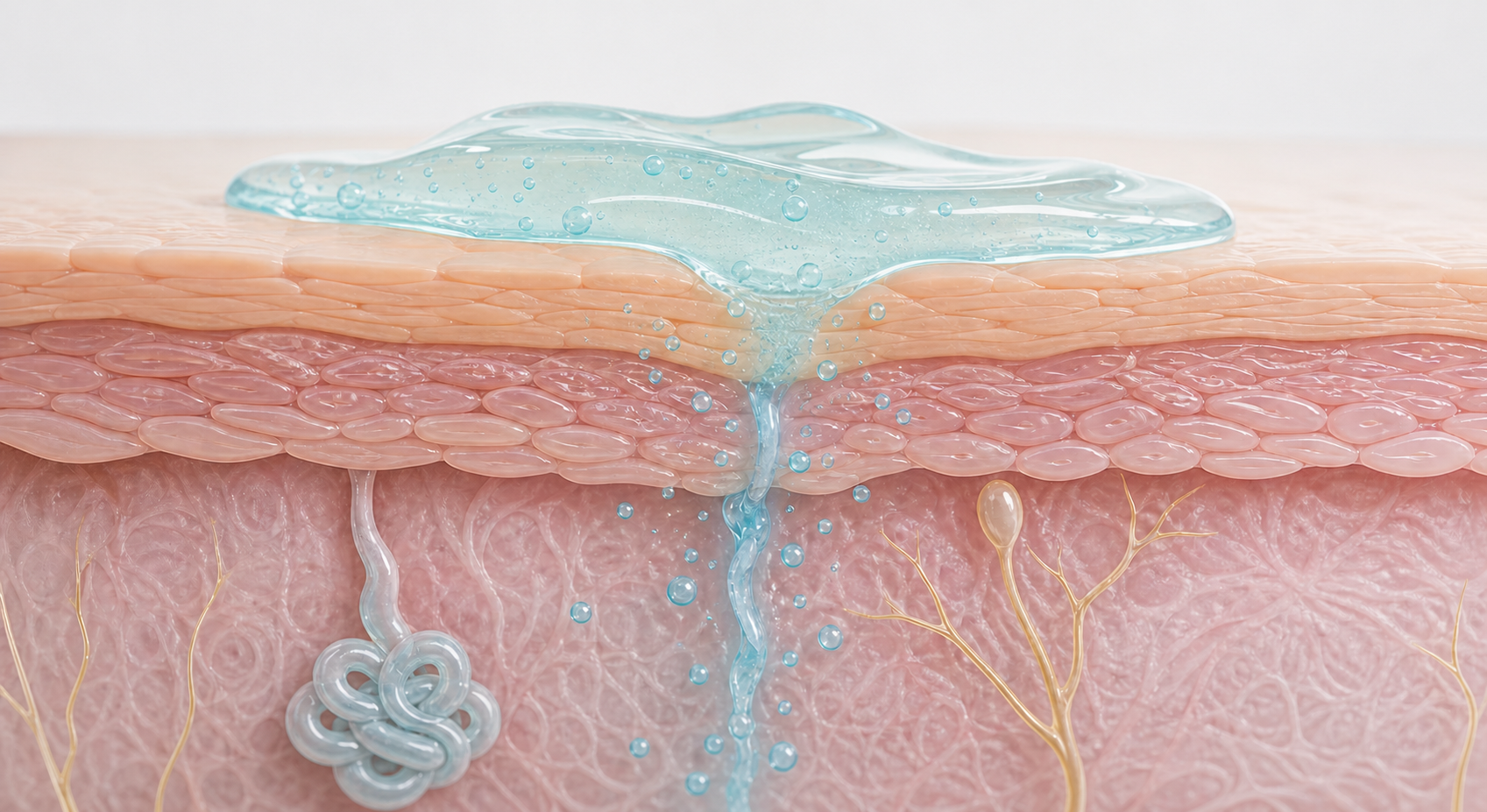
Where you apply it is where it works. Rubbed into one zone, the gel keeps its effect mostly local, quieting the glands under that patch of skin without circulating through your whole body the way a swallowed pill does.
That local action depends on getting past the skin's outer barrier, the stratum corneum, a stubborn layer built to keep things out. The gel has to move through it to reach the nerve endings underneath, which is why the base it is mixed into and the concentration both matter.
What the Research Shows
The strongest signal comes from a 2024 systematic review in JAAD Reviews. Pooling studies of 416 patients, it found that topical oxybutynin produced a clinically meaningful improvement on the Hyperhidrosis Disease Severity Scale, a four-point measure of how much sweating disrupts daily life, in 73.6% of patients versus 42.8% on placebo (p<0.00001), with side effects the authors called tolerable.
A closer look comes from a randomized, double-blind, split-area trial. In 61 patients treated with 10% gel, treated skin showed greater sweat reduction and better severity and quality-of-life scores than placebo skin at 30 days.
Timing matters when you start something new. Most patients notice initial change within one to two weeks, with full, consistent results typically appearing around the four-week mark of nightly use. [Twofold FAQ]

What is still open: studied concentrations run from roughly 1% to 20%, and the best vehicle and strength have not been settled.
How to Apply Compounded Oxybutynin Gel
Applying the gel is simpler than most nightly routines. Here is what it usually looks like:
- Apply once at night to the affected area, whether that is underarms, palms, soles, or another site.
- Start with clean, dry skin, and wash your hands right after applying so you do not carry the gel where it does not belong.
- Keep it away from your eyes, your mouth and nose, and any skin you shaved that day.
- Skip showering or soaking the treated spot for at least an hour.
- Let it dry fully, then cover the area with clothing before bed to prevent transfer to someone else's skin.
How much you apply gets set with your prescriber. Do not nudge the dose up or down on your own.
One last thing. This is not a same-night fix. Consistent nightly use over several weeks brings the full effect, and if you stop, the sweating comes back.
Side Effects and Safety Considerations
Because the gel works where you rub it in, less of the drug reaches your bloodstream than with a pill, which usually means potentially fewer body-wide anticholinergic effects. That is a general pattern, not a guarantee. Side effects are still possible.
Commonly reported side effects include mild irritation at the application site like redness or itching, dry mouth, and thirst. Some people also notice constipation, blurred vision, urinary hesitancy, or dizziness. This is not a complete list of possible side effects. [JAAD Reviews, 2024]
One effect is worth flagging. Since oxybutynin reduces sweating, it also reduces how your body sheds heat, a known anticholinergic class effect. Avoid extreme heat while using it, and take signs of overheating seriously. Alcohol can amplify side effects, so raise your drinking habits with your provider. [JAAD Reviews, 2025]
Talk to a provider before starting if any of these apply to you, including but not limited to:
- Urinary retention
- Narrow-angle glaucoma
- Gastric or stomach-emptying problems
- Myasthenia gravis
- Other anticholinergic medications you already take
This rundown is here to inform you, not to replace a conversation with a licensed provider who knows your history.
Who Compounded Oxybutynin Gel Is Right For
Compounded oxybutynin gel fits some sweat patterns better than others. A quick gut check on where you land:
- Strong fit: focal hyperhidrosis in specific zones like hands, underarms, feet, or face, especially if antiperspirants have not helped and you want something non-invasive with no needles or pills.
- The compounded angle matters here. Commercial topicals are labeled for underarms alone, while a gel mixed to order can be dialed in strength and applied to palms or soles too.
- Less ideal as a first move: whole-body sweating, where an oral anticholinergic often does more, or any contraindication to anticholinergics covered earlier.
A dermatologist or licensed provider has to review your case and decide whether it fits, or whether an alternative might be appropriate.
How Compounded Oxybutynin Gel Fits Into the Broader Treatment Ladder
Treatment for excessive sweating usually climbs a ladder, from gentlest to most invasive. Compounded oxybutynin gel sits in the middle, a reasonable next step once the basics have not done enough.
| Rung | Options | Where it fits |
|---|---|---|
| First-line | OTC clinical-strength and prescription aluminum chloride | Mild cases; try before anything stronger |
| Topical anticholinergics | Compounded oxybutynin gel, plus FDA-approved Qbrexza (glycopyrronium 2.4% cloth) and Sofdra (sofpironium 12.45% gel) | Focal sweating when antiperspirants fall short |
| Oral anticholinergics | Oral glycopyrrolate for hyperhidrosis, extended-release oxybutynin | Multi-site or whole-body sweating; more systemic side effects |
| Procedures | Botulinum toxin for hyperhidrosis, microwave thermolysis, surgery | Moderate-to-severe cases; rising cost, recovery, invasiveness |
One note on the peer-level topicals. Qbrexza and Sofdra are labeled for underarms alone and ship at a single fixed strength, while a compounded gel can be dialed in concentration and applied to palms, soles, or the face.
There is no universal answer. Where you land depends on the pattern of your sweating, its severity, and what a provider decides after looking at your case.
How Twofold Delivers Compounded Oxybutynin Gel for Hyperhidrosis
If sweating has worn on your daily life and you are still searching for how to stop sweating effectively, here is one way to reach compounded oxybutynin gel without an in-person visit. We connect you with board-certified, sweat-specialized dermatologists entirely online and asynchronously. The intake runs about 5 to 10 minutes, with a review inside roughly 24 hours.
The flagship treatment is a compounded topical oxybutynin 8% gel on a penetration-enhancing base made to carry the active ingredient through thicker-skinned zones like palms and soles, where many generic topicals stall. It dries fast, closer to hand sanitizer than a cream, skipping occlusion that can set off more sweating. Apply it once nightly on hands, feet, underarms, face, back, chest, or groin, everywhere but the scalp.
When a pill fits better, the dermatologists may also prescribe oral glycopyrrolate and extended-release oral oxybutynin, including combination plans pairing a lower oral dose with targeted topical use.
A few practical notes:
- Pricing is a flat subscription: $150 for a 3-month supply, no insurance required ($50/mo), with free shipping and unlimited dermatologist messaging included. Pricing is subject to change; see itstwofold.com for current offers.
- A satisfaction guarantee is available for eligible subscription customers; see itstwofold.com for full terms.
We are LegitScript-verified and work with 503A compounding pharmacies operating under FDA, state, and federal compounding rules.
Final Thoughts on Compounded Oxybutynin Gel and Hyperhidrosis
Sweat that disrupts your daily life deserves more than a stronger antiperspirant. Compounded oxybutynin gel is a studied topical option with a manageable side-effect profile for most people with focal hyperhidrosis who want something that works at the source. Talk to a dermatologist and see where it fits in your routine.
FAQ
Can I build a compounded oxybutynin gel routine without taking pills?
Yes. Compounded oxybutynin gel is a topical treatment applied directly to sweaty areas like hands, feet, underarms, or face, so the active ingredient works locally instead of circulating through your whole body the way an oral anticholinergic does. This makes it a practical option if you want to limit systemic side effects while still targeting specific zones.
Compounded oxybutynin gel vs. Qbrexza for palm and sole sweating?
Compounded oxybutynin gel can be applied to palms, soles, face, and other zones, while Qbrexza (glycopyrronium 2.4% cloth) is FDA-labeled for underarms only and ships at a single fixed strength. If your sweating is concentrated in areas beyond the underarms, a compounded gel gives a prescriber more flexibility on both where it is used and what concentration is mixed.
How long does compounded oxybutynin gel take to work for hyperhidrosis?
Most people notice initial change within one to two weeks of consistent nightly use, with full, steady results typically appearing around the four-week mark.
What is the difference between compounded oxybutynin gel and commercial oxybutynin gel like Gelnique?
Gelnique is a commercial oxybutynin gel approved for overactive bladder, not sweating. Compounded oxybutynin gel is mixed to order by a licensed pharmacy at a concentration chosen by your prescriber, and often prepared with a penetration-enhancing base designed to move through thicker skin on areas like palms and soles, where many off-the-shelf topicals lose effectiveness before reaching the nerve endings they need to reach.
Who should talk to a provider before using compounded oxybutynin gel?
Anyone with urinary retention, narrow-angle glaucoma, gastric-emptying problems, myasthenia gravis, or who already takes other anticholinergic medications - among other conditions and medications - should discuss those factors with a licensed provider before starting. This is not an exhaustive list. Because oxybutynin reduces sweating, it also reduces how your body sheds heat, so your provider needs a full picture of your health history to weigh that risk properly.
If you see a mistake or something you think should be updated, let us know at hello@itstwofold.com!


