

If your hands sweat through a handshake or your underarms soak through within an hour of getting dressed, you already know how much this gets in the way of daily life. Topical oxybutynin has been getting more attention as a treatment for exactly this kind of localized sweating, and the way it works at the skin level is what sets it apart from the oral version most people have heard about.
TLDR:
- Topical oxybutynin works by blocking the nerve signal that tells your sweat glands to fire, applied right where you sweat.
- Applied to skin, oxybutynin largely skips that route, so far fewer systemic side effects form compared to the pill. [JAAD Reviews, 2024]
- A 2024 JAAD Reviews systematic review found 73.6% of patients improved on topical oxybutynin vs. 42.8% on placebo.
- Systemic side effects like dry mouth showed up in under 1% of participants in that same review. [JAAD Reviews, 2024]
- Twofold is a virtual sweat clinic where a board-certified dermatologist reviews your intake and can prescribe treatment like a compounded topicals, or oral medications for hyperhidrosis.
What Topical Oxybutynin Is
Oxybutynin is an anticholinergic, sometimes called an antimuscarinic, which is a plain way of saying it blocks a specific chemical messenger in your body. For years, doctors have prescribed it in pill form to calm an overactive bladder. That is its original, FDA-approved job.
Using it for sweating is a different story. When dermatologists reach for oxybutynin to quiet excessive sweat, they are prescribing it off-label, meaning outside its official approval. That practice is common, legal, and well accepted in dermatology.
"Topical" simply means you put it on your skin instead of swallowing it. You will see it made up as a gel, lotion, cream, or spray that goes right where you sweat.
How Topical Oxybutynin Works
Sweating starts with a signal. Your nerves release acetylcholine, a chemical messenger, and that messenger lands on receptors sitting on your eccrine sweat glands, the ones behind most everyday sweat. Oxybutynin steps in as a muscarinic receptor antagonist, plugging those receptors so the acetylcholine signal never fully lands. No signal, less sweat.
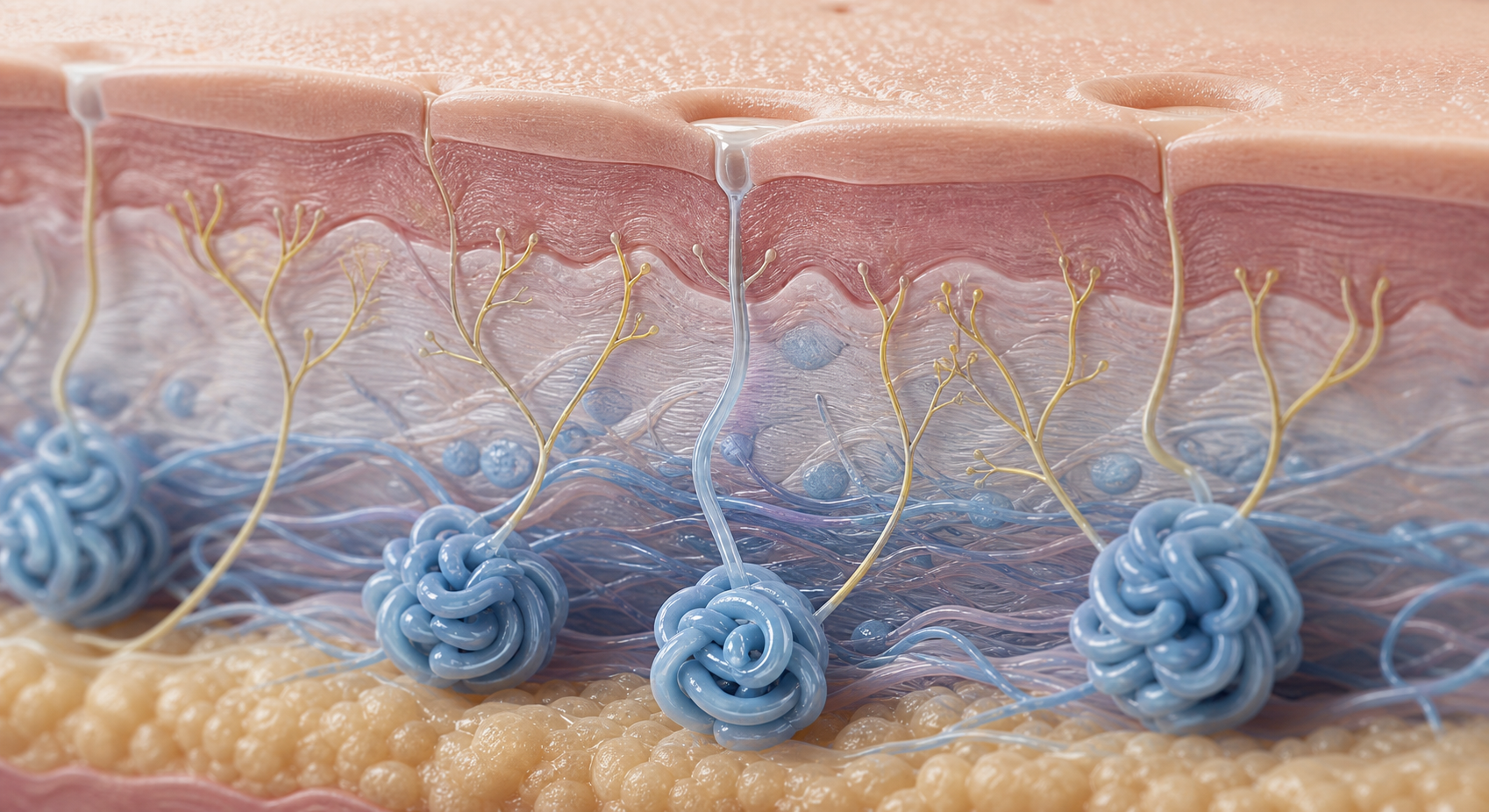
Applied to your skin, the drug works right at the surface it touches, staying close to the application site instead of circulating through your whole body.
That local action helps. Swallowed as a pill, oxybutynin for sweating passes through your gut and liver first, a step called first-pass metabolism. That spins off N-desethyloxybutynin, or N-DEO, the active metabolite behind most of the dry mouth, blurred vision, and other anticholinergic effects people link to the pill. Applied to skin, oxybutynin largely skips that route, so far less N-DEO forms.
Topical vs. Oral Oxybutynin
Oral oxybutynin is not new to hyperhidrosis. Dermatologists have prescribed the pill for years, and it can work well, particularly when sweating is generalized or spread across too many zones for a topical to reach comfortably. The catch is the side effect load that comes with sending the drug through your whole system. A 2025 review found oral oxybutynin improved symptoms in 60% to 97% of patients, though systemic anticholinergic effects including dry mouth, blurry vision, constipation, and cognitive fog are common trade-offs with the pill.
Topical application keeps the drug close to where you put it, which is why the same active tends to be gentler on the rest of your body.
| Topical oxybutynin | Oral oxybutynin | |
|---|---|---|
| Delivery | Applied to skin | Swallowed |
| Side effect reach | Mostly local | Body-wide |
| Best suited for | Focal, localized sweating | Generalized sweating |
Neither one wins outright. A dermatologist weighs your pattern and picks accordingly.
Body Areas Topical Oxybutynin Can Treat
One of the first things people want to know is whether topical oxybutynin reaches their particular problem area. The documented treatment sites cover most of where focal sweating shows up:
- Axillae (underarms)
- Palms
- Soles of the feet
- Face
- Back
- Chest
- Groin
Not every area behaves the same under a topical, though. Your palms and soles are covered by a much thicker outer layer of skin called the stratum corneum, a challenge also relevant to iontophoresis for hyperhidrosis, the dead-cell barrier at the surface. It runs far denser there than on your underarms or face, and that density gets in the way of the active ingredient reaching the sweat glands underneath.
Which is why the vehicle, the base a formulation is mixed into, carries so much weight. A base built to push the drug through thick skin can make the difference between a gel that works for sweaty hands treatment and one that mostly sits on top.
What the Clinical Evidence Shows
The strongest single piece of evidence is a 2024 systematic review in JAAD Reviews that pooled 8 studies covering 593 participants. Across that data, topical oxybutynin improved Hyperhidrosis Disease Severity Scale scores by at least one point from baseline in 73.6% of patients, making it one of several options for reducing excessive sweating, compared with 42.8% on placebo.
The quality-of-life numbers moved too. Measured by the Dermatology Life Quality Index, 72.3% of treated patients saw improvement versus 44.9% on placebo, and 75% reported satisfaction with treatment. [JAAD Reviews, 2024]
One fair caveat: the same reviewers flag the need for larger prospective randomized trials to pin down the most effective vehicle and concentration. The evidence is real and growing, though still maturing.
Side Effects and Safety Profile
Most side effects fall into two buckets, and the split matters when you are weighing this against a pill.
Local reactions at the application site are the common ones: mild irritation, dryness, redness, itching, or dermatitis where the gel goes. In the JAAD Reviews systematic review of 416 patients, application site reactions were the most frequently reported adverse effect.
Systemic anticholinergic effects like dry mouth, dry eyes, constipation, and blurry vision turned up in fewer than 1% of participants in the JAAD Reviews systematic review, well below what oral formulations tend to cause, and far less invasive than Botox for hyperhidrosis.
A few habits cut down local irritation. Apply to clean, dry skin. For underarms, wait a couple of days after shaving before you start.
None of this replaces a conversation with a provider about your own health situation.
Who May Be a Candidate for Topical Oxybutynin
Topical oxybutynin is generally considered for primary focal hyperhidrosis, meaning heavy sweating in a specific area like your underarms, hands, feet, or face that is not driven by another medical condition. It often comes up when prescription strength antiperspirants have not given enough relief.
Some people should be cautious. These are examples of things to raise with a provider early, not a complete list:
- Urinary retention, which oxybutynin can worsen by affecting how your bladder empties
- A gastrointestinal blockage or slowed digestion that could be aggravated
- A known sensitivity or past reaction to oxybutynin
A licensed clinician, not a self-assessment, decides whether it fits your situation. This section is general information, not medical advice, so talk with a provider about your own health before starting anything.
How Twofold Approaches Topical Oxybutynin for Hyperhidrosis
At Twofold, we run a virtual sweat clinic. You complete an online intake, a board-certified dermatologist who specializes in sweat reviews it within about 24 hours, and there is no live appointment to schedule. No waiting room either.
A flagship treatment available is a compounded topical oxybutynin 8% gel applied once nightly. It sits on a penetration-enhancing base built to carry the medication through thicker skin like the palms and soles, and it dries fast and skips aluminum entirely. When a pattern fits oral treatment better, the dermatologists may also prescribe oral glycopyrrolate for hyperhidrosis or extended-release oxybutynin, including combination plans.
Pricing is flat at $150 for a 3-month supply, shipping is free, follow-up messaging is unlimited, and no insurance is needed. Medication ships within 2 to 5 business days.
Final Thoughts on How Topical Oxybutynin Treats Hyperhidrosis
Topical oxybutynin works by blocking the signal that tells your sweat glands to fire, and doing that at the skin surface keeps most side effects local instead of body-wide. The clinical evidence backs it up as a real option for focal hyperhidrosis. Your next move is a conversation with a dermatologist who can look at your specific pattern and point you in the right direction.
FAQ
Topical oxybutynin vs. oral oxybutynin for hyperhidrosis: which one should you use?
It depends on your sweat pattern. Topical oxybutynin works best for focal sweating in specific areas like your hands, feet, underarms, or face, because the drug stays close to where you apply it and produces far fewer systemic side effects. Oral oxybutynin tends to be the better fit when sweating is generalized or spread across too many zones for a topical to reach comfortably, though it carries a higher risk of dry mouth, blurry vision, and other anticholinergic effects.
Can topical oxybutynin actually penetrate thick skin on your palms and feet?
Yes, but the base formula matters enormously. The stratum corneum on your palms and soles is far denser than on your underarms or face, which means a standard topical can sit on the surface without reaching the sweat glands underneath. Formulations built with penetration-enhancing ingredients are purpose-built to push the medication through that thicker barrier.
How long does topical oxybutynin take to work for hyperhidrosis?
Based on clinical reports, most people notice initial change within 1 to 2 weeks of nightly use, with more consistent results typically appearing around the 4-week mark. Results are not permanent: if you stop treatment, sweating returns.
What are the side effects of topical oxybutynin for hyperhidrosis?
The most common side effects are local reactions at the application site: mild dryness, redness, itching, or irritation. A 2024 systematic review in JAAD Reviews found systemic anticholinergic effects like dry mouth and blurry vision showed up in fewer than 1% of participants, well below rates seen with oral oxybutynin. Applying to clean, dry skin and waiting a couple of days after shaving before applying to underarms can help reduce local irritation.
How does Twofold's compounded topical oxybutynin 8% gel differ from other topical oxybutynin options?
Twofold's gel is compounded with a penetration-enhancing base built to carry the medication through thicker-skinned areas like the palms and soles, which is a known weak point for many standard topical formulations. It is aluminum-free, fast-drying, and applied once nightly. Because it is compounded fresh per prescription, dosing can be adjusted by a dermatologist based on your body and treatment area. Note that as a compounded product, it is not separately FDA-approved, and its use for hyperhidrosis is off-label.
If you see a mistake or something you think should be updated, let us know at hello@itstwofold.com!


