

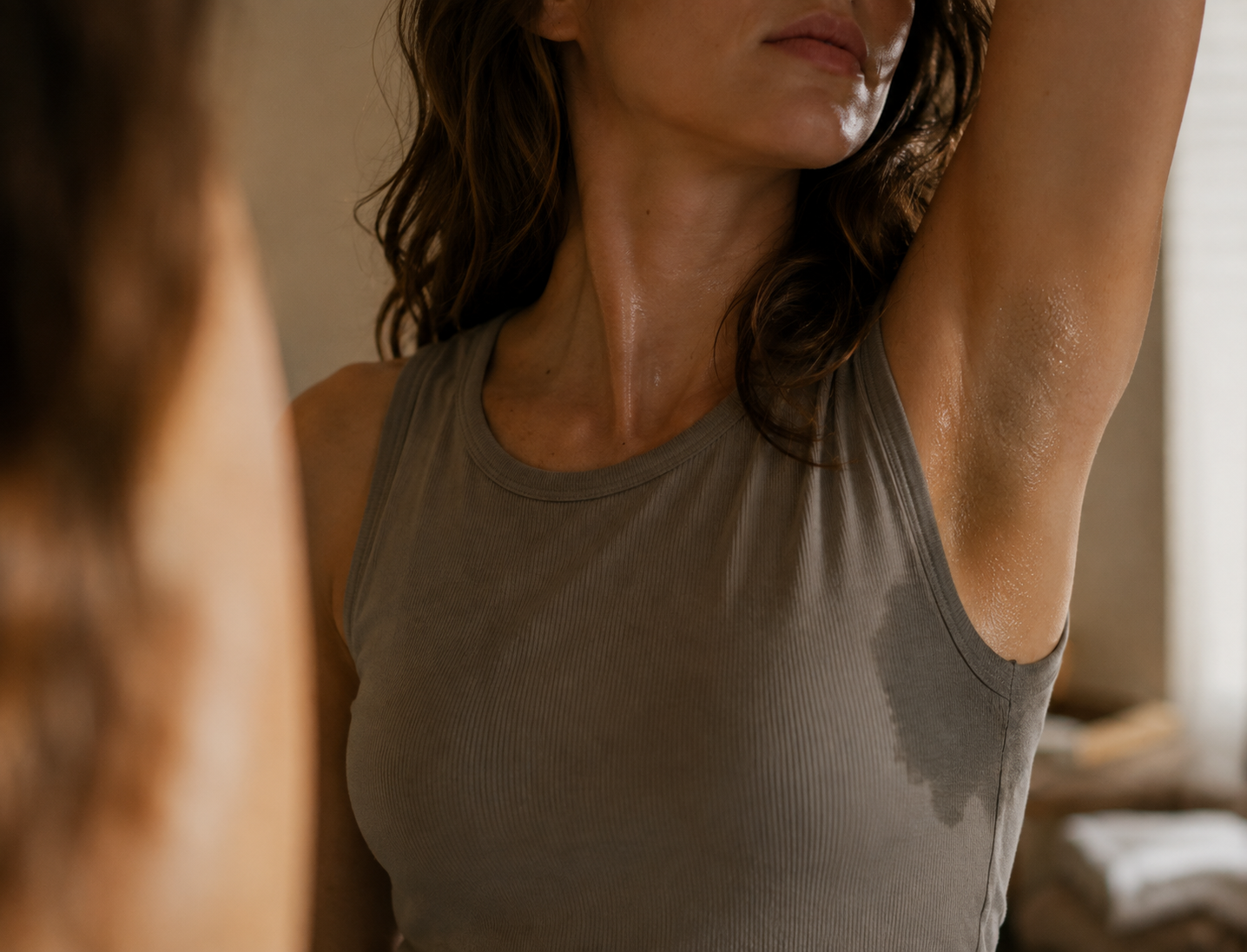
Your armpits don't care that the room is air conditioned or that you're just sitting at your desk. For people with axillary hyperhidrosis, the sweating happens constantly and often without any trigger you can point to. Understanding the condition, from what causes it to how it gets treated, makes figuring out your next move a whole lot easier.
TLDR:
- Axillary hyperhidrosis affects 50.8% of people with hyperhidrosis, making underarms the most common site.
- If you sweat through shirts with no clear trigger, you may have primary hyperhidrosis, not simply "bad sweating."
- Treatment options range from prescription antiperspirants to Botox to miraDry, but none permanently resolve the condition, since sweating returns if you stop.
- Lifestyle changes like nighttime antiperspirant application and cutting caffeine help, but rarely manage clinical-grade sweating alone.
- Twofold is a virtual sweat clinic where dermatologists may prescribe - if appropriate - topical and oral treatments for hyperhidrosis online.
What Is Axillary Hyperhidrosis
Axillary hyperhidrosis is a medical condition where the sweat glands in your underarms produce far more sweat than your body needs to cool down. Your armpits soak through a shirt when the room is cool, when you're sitting still, when there's no reason to sweat at all.
It falls under focal hyperhidrosis, meaning the excessive sweating stays confined to specific areas instead of covering you head to toe. Of all the focal areas, the underarms are affected most often. A national survey found that 50.8% of people with hyperhidrosis report axillary involvement, making it the most common location by a wide margin.
For some people the underarms are the only trouble spot. For others, they sweat alongside the palms, soles, or face.
What Causes Excessive Underarm Sweating
Underarm sweating splits into two categories, and figuring out which one you have matters more than it might seem.
Primary Axillary Hyperhidrosis
This is the idiopathic type, meaning there's no underlying disease behind it. The eccrine sweat glands in your underarms stay overactive because of an oversensitive sympathetic nervous system, the part of your body that controls excessive underarm sweating without asking your permission. It often runs in families and usually starts before age 25. Stress, heat, and spicy food tend to make it worse.
Secondary Axillary Hyperhidrosis
Here the sweating is a symptom of something else. Thyroid disorders, diabetes, menopause, obesity, infections, and neurological conditions like Parkinson's disease can all trigger it, as can certain medications including antidepressants and antipsychotics.
Two clues point toward secondary: sweating that continues while you sleep, and sweating that spreads across your whole body instead of staying in one spot.
Symptoms of Axillary Hyperhidrosis
The clearest sign is sweat you can see. Visible, dripping wetness under your arms shows up without heat, without a workout, sometimes for no reason you can name. It soaks through fabric fast, leaving dark rings and stiff, discolored patches that don't wash out. Wondering about sweating too much from armpits even with deodorant? Clinical-strength antiperspirant barely dents the flow.
Beyond the mess, the disruption tells its own story. You change shirts midday, angle away from handshakes, or plan outfits around what hides sweat marks.
Dermatologists use a checklist to separate ordinary sweating from primary axillary hyperhidrosis. You likely fit the pattern if several apply:
- Excessive sweating lasting six months or longer with no clear cause
- Sweating on both underarms in a roughly symmetrical way
- At least one heavy episode per week
- Symptoms that began before age 25
- A family history of the same problem
- Sweating that stops once you fall asleep
- Enough interference with work, relationships, or routines to genuinely bother you
Meeting most of these points toward the primary type, though only a provider can confirm it.
How Axillary Hyperhidrosis Is Diagnosed
A dermatologist usually starts with the same clinical criteria you saw in the symptoms checklist. The standard diagnostic framework asks for visible, focal sweating lasting at least six months with no apparent cause, plus at least two additional supporting features such as symmetric distribution, onset before age 25, episodes occurring at least weekly, a family history of the same problem, or sweating that stops during sleep.[3]
From there, a few simple tests confirm and measure what's happening:
- Starch-iodine test: iodine painted on the skin, dusted with starch, turns dark blue wherever sweat surfaces, mapping where you're overactive.
- Gravimetric testing: absorbent paper weighed before and after a set time quantifies how much sweat your underarms produce.
- Blood or imaging tests: bloodwork or scans rule out secondary drivers like thyroid dysfunction or diabetes.
To grade severity, providers lean on the Hyperhidrosis Disease Severity Scale (HDSS), a four-point self-rating running from sweating that never interferes with daily life up to sweating that always does. Learn more about hyperhidrosis symptoms and treatments for broader context. A score of 3 or 4 signals severe disease, and that number often decides how aggressively treatment gets escalated.
Treatment Options for Axillary Hyperhidrosis
Clinicians rarely jump to the strongest option first. Treatment climbs a ladder, starting with the least invasive approach and escalating only when something falls short.
| Treatment | How it works | What to know |
|---|---|---|
| Clinical-strength and prescription antiperspirants | Aluminum chloride salts plug sweat ducts | OTC formulas (12-20%) are first-line for mild cases; prescription strength (20% aluminum chloride hexahydrate) steps in when they fall short. Main trade-off is irritation, including burning and contact dermatitis |
| Topical anticholinergics | Block acetylcholine at the sweat gland | Includes glycopyrronium (Qbrexza) and sofpironium bromide (Sofdra), plus compounded options, like 8% oxybutynin gel. Topical anticholinergics have the potential for lower systemic absorption than oral forms, the basis for fewer body-wide side effects, though individual tolerability still varies.[1] |
| Oral anticholinergics | Glycopyrrolate or oxybutynin taken systemically | Useful for generalized or multi-site sweating. Commonly reported side effects include dry mouth.[2] This is not a complete list of possible side effects. |
| Iontophoresis for hyperhidrosis | Mild electrical current through water reduces gland activity | Better supported for palms and soles; the underarm may be awkward to treat this way |
| Botox for hyperhidrosis | Injected into underarm skin to block nerve signals | Effects usually last 4 to 6 months, then repeat sessions are needed |
| miraDry treatment | Microwave energy destroys underarm sweat glands | One or two sessions, long-lasting, but can't reach other sweating zones |
| Surgery (ETS, sweat gland removal) | Cuts sympathetic nerves or excises glands | Last resort for severe cases; compensatory sweating a reported risk |
A 2024 systematic review found oxybutynin for sweating produced a meaningful HDSS improvement in 73.6% of patients versus 42.8% on placebo. A 2025 meta-analysis confirmed strong efficacy and safety for botulinum toxin A in primary axillary hyperhidrosis.
Worth saying plainly: none of these cure the condition. They manage it, and sweating returns if you stop.
Natural and Lifestyle Approaches to Managing Underarm Sweating
To be upfront about what these changes do: adjusting your habits can lower how often triggers fire and take some edge off a sweaty day. What they generally can't do is manage clinical-grade axillary hyperhidrosis on their own. Think of them as a foundation, not a fix.
A few adjustments genuinely help:
- Trim dietary triggers. Spicy foods, caffeine, and alcohol nudge the sympathetic nervous system toward more sweat, so cutting back softens the spikes.
- Rethink your fabrics. Breathable, moisture-wicking materials pull sweat away from the skin, while tight synthetic shirts trap heat and moisture.
- Fix your antiperspirant timing. Apply it at night to clean, dry skin. Sweat production slows while you sleep, giving the aluminum salts a better shot at plugging the ducts.
- Manage stress where you can. Anxiety is a recognized trigger for primary hyperhidrosis, and breathing exercises, sleep, and movement lower your baseline reactivity.
- Keep the area clean. Regular washing curbs the bacteria that turn moisture into odor.
If you've tried all of this and your shirts are still soaked, that's not a personal failing. It usually means the sweating runs deeper than lifestyle can reach. Talking to a provider about clinical treatments is a reasonable next step.
How Axillary Hyperhidrosis Affects Daily Life
The numbers put scale to something that can feel isolating. According to a frequently cited 2016 national survey, about 4.8% of the U.S. population, or roughly 15.3 million Americans, live with some form of hyperhidrosis,[4] and around 75% report negative effects on their mental health, social relationships, and emotional well-being.[4]
The toll shows up in quiet decisions. You pass on the gym class with light-colored uniforms, sit out the group photo, or turn down the promotion that means presenting to a room. Work suffers when you're gripping a mouse through damp sleeves. Friendships thin out when going anywhere feels like a calculation about escape routes.

That constant management wears people down. People with hyperhidrosis are more anxious and depressed than other dermatology patient groups, per a 2020 systematic review.
Yet only about half ever raise their symptoms with a provider. If you've been quietly coping for years, you are far from alone, and it is worth the conversation.
Managing Axillary Hyperhidrosis with Twofold
If you've worked through the ladder above and still feel stuck, that gap between knowing treatment exists and actually getting it is where many people stall. We built Twofold to close it.
We're a virtual sweat clinic connecting you with sweat-specialized dermatologists entirely online, no waiting room required. Our flagship treatment is a compounded oxybutynin gel applied once nightly. Built on a penetration-enhancing base called EverdryRx, it's formulated to help the medication penetrate through to where the sweat glands are. The gel is aluminum-free and quiets the nerve signal to your sweat glands instead of plugging ducts. When an oral approach fits better, our dermatologists also prescribe glycopyrrolate vs oxybutynin options, including combination plans.
The process is short:
- Complete a free online intake, about 5 to 10 minutes covering your history and symptoms.
- A licensed dermatologist reviews it and responds within roughly 24 hours.
- If a prescription is written, your medication ships in 2 to 5 business days.
No in-person visits. A 3-month supply runs $150, with a 4-week money-back guarantee for subscription customers who complete the full regimen, plus multi-bottle plans for larger areas.
A few things worth stating plainly. Oxybutynin is FDA-approved for overactive bladder, so its use for hyperhidrosis is off-label, a common and accepted dermatology practice. Because our gel is compounded, the product itself is not separately FDA-approved. Results aren't guaranteed, and sweating typically returns if you stop. For anything specific to your health, talk with a provider.
Final Thoughts on Understanding and Treating Underarm Sweating
If your armpits sweat through shirts in a cool room and deodorant does nothing, that pattern has a name and a treatment path. The options range from topical prescriptions to longer-term procedures, and the right fit depends on your severity and lifestyle. Getting a proper diagnosis is the most useful first move you can make.
FAQ
Why do my armpits sweat so much even with deodorant?
Standard deodorant controls odor but does nothing to reduce sweat volume. Clinical-strength antiperspirants with aluminum chloride salts actually plug the sweat ducts, which is why dermatologists recommend them as a first step for axillary hyperhidrosis. If even prescription-strength antiperspirant barely dents the sweating, that's a signal the condition may run deeper than a topical duct-blocker can reach.
What's the difference between miraDry and topical oxybutynin for axillary hyperhidrosis treatment?
miraDry uses microwave energy to destroy underarm sweat glands in one or two sessions, which tends to produce long-lasting results but only works on the underarms and comes with a higher upfront cost. Topical oxybutynin works by blocking the nerve signal to sweat glands (without destroying them), costs less, and can be applied across multiple zones like the hands, feet, or face. The right fit depends on how many areas are affected, your budget, and how you weigh a one-time procedure against an ongoing nightly routine.
How do I stop underarm sweating permanently without surgery?
No current non-surgical treatment stops underarm sweating permanently. Botox for axillary hyperhidrosis typically lasts 4 to 6 months before repeat sessions are needed, while topical and oral anticholinergics like oxybutynin and glycopyrrolate manage sweating only while you're actively using them. miraDry comes closest to a lasting result without surgery, though provider consultation is the right starting point for choosing among these options based on your specific symptoms.
Can axillary hyperhidrosis be a sign of something more serious?
Excessive underarm sweating can be either primary (no underlying cause) or secondary, where it signals something else going on. Secondary axillary hyperhidrosis causes include thyroid disorders, diabetes, menopause, and certain medications like SSRIs and antipsychotics. Two patterns worth raising with a provider: sweating that continues while you sleep, or sweating that spreads across your whole body instead of staying in one area.
What is the Twofold topical oxybutynin 8% gel and how does it compare to Qbrexza for axillary hyperhidrosis?
Both are topical anticholinergics that block acetylcholine signals to reduce sweat production, but they differ in formulation and scope. Qbrexza is an FDA-approved glycopyrronium wipe cleared exclusively for primary axillary hyperhidrosis, while Twofold's compounded oxybutynin 8% gel is an off-label compounded product built on a penetration-enhancing base that lets it be applied across multiple zones including the hands, feet, face, and more. Twofold also pairs the prescription with ongoing dermatologist access through a fully virtual process, which may suit people who want multi-site coverage without separate appointments.
If you see a mistake or something you think should be updated, let us know at hello@itstwofold.com!


