

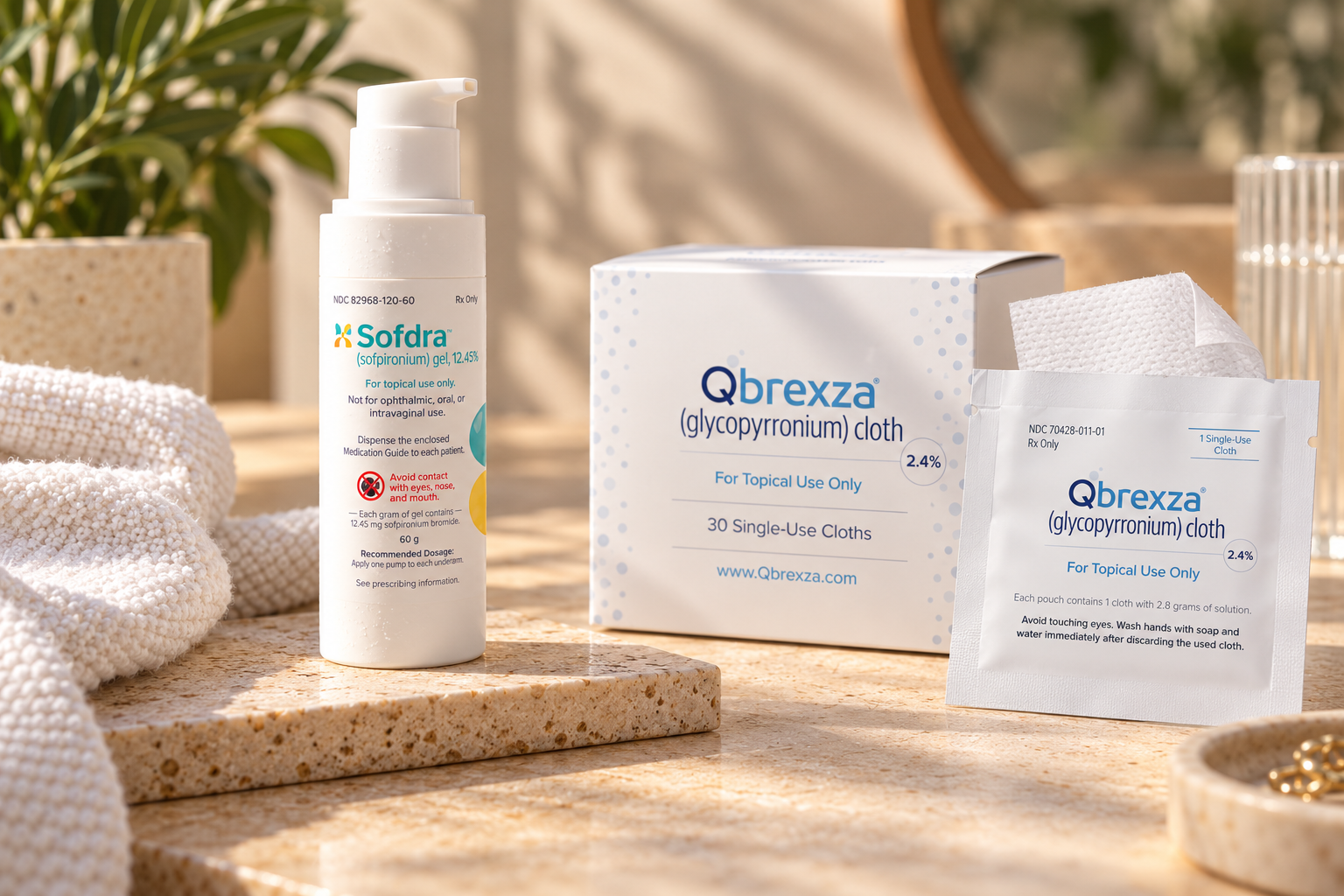
Both of these prescriptions promise drier underarms, so how do you choose? Sofdra is a gel, Qbrexza is a wipe, and beyond that they share a lot: the same drug family, the same target zone, similar side effects, and similar sticker prices. We'll break down where they genuinely differ so you can match one to your sweat, your budget, and the routine you'll actually keep up with.
TLDR:
- Sofdra (sofpironium 12.45% gel) and Qbrexza (glycopyrronium 2.4% cloth) are both FDA-approved for underarm sweating only.
- Sofdra trials showed about 85% improvement, Qbrexza about 60%, but different studies mean these are not head-to-head numbers.
- Both can cost around $550+ - $900+ at retail, with $0 copay programs limited to eligible commercially insured patients.
- Neither is FDA-approved to treat hands, feet, or face, so pick based on where you sweat, your coverage, and your routine.
- Twofold connects you with dermatologists who can prescribe - if appropriate - a compounded oxybutynin gel or oral medication options for multiple zones.
What Is Sofdra and How Does It Work?
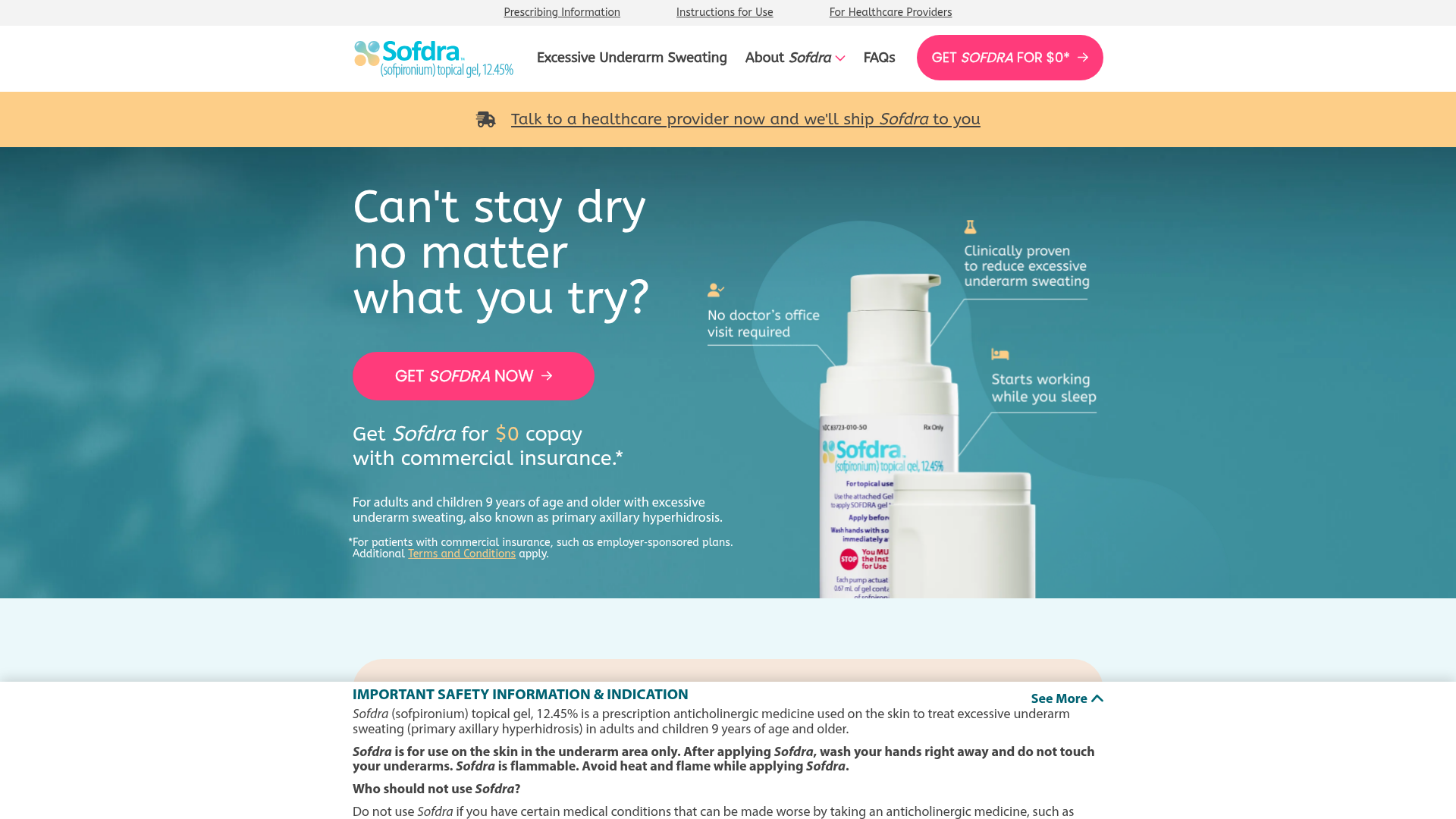
Sofdra is a prescription topical gel containing sofpironium 12.45%, applied to the underarm to treat primary axillary hyperhidrosis (excessive underarm sweating) in adults and children 9 and older. It works as an anticholinergic, blocking acetylcholine receptors on the sweat glands to reduce how much they produce. It gained FDA approval on 18 June 2024.
The routine is simple. Using the provided applicator, you apply one pump per underarm at bedtime.
Sofdra is made by Botanix and sold through a telehealth portal instead of a standard pharmacy counter.
What Is Qbrexza and How Does It Work?
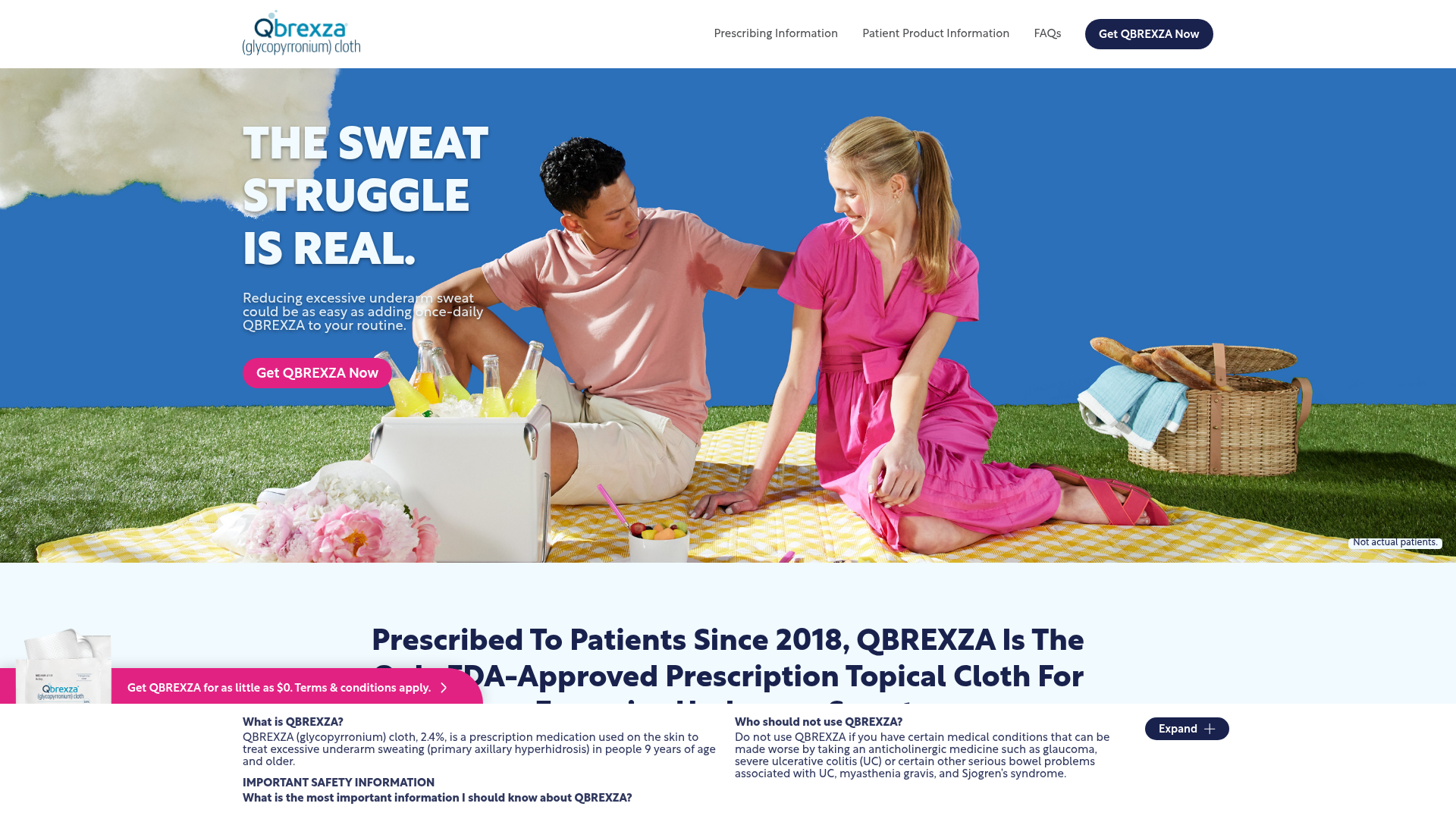
Qbrexza is a prescription anticholinergic delivered as a pre-moistened cloth. The glycopyrronium cloth treats axillary hyperhidrosis, and was FDA-approved in June 2018.
The mechanism mirrors Sofdra's. Glycopyrronium blocks acetylcholine receptors on sweat glands, so it reduces the signal that triggers sweating.
Application is quick: tear open the pouch, unfold the cloth, wipe it across one entire underarm once, then use the same cloth on the other underarm once.
Sofdra vs Qbrexza: Key Differences at a Glance
Both drugs sit in the same anticholinergic family, and both carry underarm-only labels. Here is how they line up side by side.
| Attribute | Sofdra | Qbrexza |
|---|---|---|
| Active ingredient | Sofpironium | Glycopyrronium |
| Concentration | 12.45% | 2.4% |
| Delivery format | Gel | Pre-moistened cloth |
| FDA approval year | 2024 | 2018 |
| FDA-approved zone | Underarms only | Underarms only |
| Dosing frequency | Once daily, at bedtime | Once daily |
| Application method | Pump onto provided applicator | Wipe cloth across each underarm |
Qbrexza is labeled for the underarm area only, and Sofdra is likewise indicated for axillary sweating.
How Effective Is Each Treatment?
Each drug arrives with its own trial base, so the numbers describe different studies instead of a direct contest.
Sofdra's evidence comes from pooled Phase 3 Cardigan I/II data, where about 85% of patients showed HDSM-Ax improvement versus vehicle (p<0.0001).
Qbrexza was studied in the ATMOS-1 and ATMOS-2 registration trials, where ATMOS trial results showed 60% reported improvement versus 28% on vehicle.
Concentration matters. A lower-strength 5% sofpironium version (Ecclock), approved in Japan in 2020, produced a more modest 53.9% response versus 36.4% for vehicle.
Because the trials used different endpoints, populations, and tools, lining these up as a head-to-head score would mislead. Read them as separate signals, not a ranking.
Side Effects and Safety Considerations
Because both drugs belong to the same anticholinergic class, their safety profiles look alike.
Commonly reported side effects for Sofdra include dry mouth, blurry vision, and irritation. For Qbrexza, commonly reported side effects include dry mouth, blurry vision, and constipation. This is not a complete list of possible side effects.
Both carry shared anticholinergic warnings. They are contraindicated in conditions that can be worsened by anticholinergic effects, including but not limited to glaucoma, paralytic ileus, severe ulcerative colitis, myasthenia gravis, and Sjögren's syndrome. Use caution around urinary retention and heat illness. Both are also flammable. Talk with a provider before starting either.
Cost and Insurance Comparison
Price is often where these two land in the same place, and neither is cheap at the counter.
Sofdra's 12.45% gel is priced from around $975.63 for 40.2 milliliters at retail. Qbrexza runs about $939.33 for one 30-pad box, which coupons can bring down to roughly $653.33. A typical box lasts one month.
Both offer $0 copay programs, but only for eligible commercially insured patients. The Qbrexza offer is not valid for Medicare, Medicaid, or federal or state programs, and Qbrexza is not covered by most Medicare plans. Affordability, for both, hinges on the right insurance.
Which Body Areas Can Each Treatment Cover?
Both drugs share the same footprint, and it is a narrow one. Glycopyrronium cloths are FDA approved, and Sofdra is likewise indicated for the underarms only.
For anyone whose sweating shows up elsewhere, that label is a hard ceiling. Palmar (hands), plantar (feet), facial, or multi-zone hyperhidrosis falls outside what either product is FDA-approved to treat.
Hands and feet add a wrinkle. Their skin is much thicker than underarm skin, which historically makes it harder for a topical to penetrate deep enough to work. A product built for the axilla is not necessarily made with those zones in mind.
How the Telehealth and Care Experience Compares
Getting each product follows a familiar prescription path. Sofdra is available through a dedicated telehealth portal with home delivery. Qbrexza is prescribed by a provider and filled at a retail or mail-order pharmacy.
Once you start, the routine is fixed by the label. Both are once-daily underarm applications, and for Qbrexza, neither dosage nor timing should be adjusted.
That makes both pathways largely transactional: a prescription, a refill, and a set routine. Ongoing back-and-forth with a clinician to adjust your dose or troubleshoot is not a built-in part of either experience.
Which Prescription Is Better for You?
The right pick depends less on which drug is stronger and more on where you sweat, how you are insured, and which routine you will actually stick to.
- Underarm-only sweating with qualifying commercial insurance: either product may be accessible at low cost through its copay program.
- Format preference: Sofdra uses a gel and applicator, while Qbrexza is a pre-moistened cloth. That is a real choice, and a personal one.
- Sweating beyond the underarms: both are limited, since each is FDA-approved for axillary use only.
Tolerability varies from person to person, so talk with a provider about which fits your symptoms, your coverage, and your daily routine.
How Twofold Offers a Multi-Zone Alternative
Both Sofdra and Qbrexza stop at the underarm. If your sweating shows up on your hands, feet, or face too, that ceiling is the real problem, and topical oxybutynin for hyperhidrosis is one option designed to cover more zones. Living with sweat that spreads beyond your underarms is exhausting, and a treatment that only covers one spot can leave you managing the rest on your own. That gap is exactly where we built Twofold differently, connecting you with dermatologists who can treat the areas an underarm-only label leaves behind.
Twofold is a virtual sweat clinic connecting you with board-certified, sweat-specialized dermatologists who prescribe a compounded topical oxybutynin gel made for multiple zones: hands, feet, face, underarms, back, chest, and groin.
How it runs:
- Flat pricing at $150 for a 3-month supply ($50/mo), no insurance required.
- Asynchronous dermatologist review within about 24 hours, then delivery in 2 to 5 business days.
- Unlimited follow-up messaging, so your dose gets titrated with a dermatologist over time.
When it fits better clinically, the dermatologists can also prescribe oral glycopyrrolate or oral extended-release oxybutynin, including combination plans.
Results are not permanent, and sweating returns if you stop. For personal health questions, talk with a provider.
Final Thoughts on Picking Sofdra or Qbrexza
Bring your symptoms and insurance details to a provider, and if the sweating reaches beyond your underarms, Twofold can help you cover more ground. The real question is where you sweat and which routine you'll keep up with.
FAQ
What is the main difference between Sofdra and Qbrexza?
Sofdra uses sofpironium 12.45% in a gel applied with an applicator, while Qbrexza uses glycopyrronium 2.4% delivered as a pre-moistened cloth. Both are once-daily anticholinergics FDA-approved for underarm sweating only, so the biggest practical difference is format preference.
Are Sofdra and Qbrexza better than Twofold for sweating on your hands and feet?
Both Sofdra and Qbrexza are FDA-approved for the underarms only, whereas Twofold's compounded topical oxybutynin 8% gel is made for multiple zones including hands, feet, face, underarms, back, chest, and groin.
How much do Sofdra and Qbrexza cost without insurance?
Sofdra runs around $975.63 for 40.2 milliliters at retail, and Qbrexza is about $939.33 for a one-month box, which coupons can lower to roughly $653.33. Both offer $0 copay programs, but only for eligible commercially insured patients, and Qbrexza's offer excludes Medicare, Medicaid, and federal or state programs.
Which side effects are common with Sofdra and Qbrexza?
Because both belong to the anticholinergic class, they share side effects like dry mouth and blurry vision, with irritation reported for Sofdra and constipation for Qbrexza. This is not a complete list of possible side effects, and both carry warnings for conditions like glaucoma and myasthenia gravis, so talk with a provider before starting either.
Can you adjust your dose with Sofdra or Qbrexza over time?
Both follow a fixed once-daily routine set by the label, and ongoing clinician back-and-forth to troubleshoot or titrate your dose is not built into either pathway. Twofold works differently by including unlimited follow-up messaging so a dermatologist can adjust your dose over time.
If you see a mistake or something you think should be updated, let us know at hello@itstwofold.com!


