

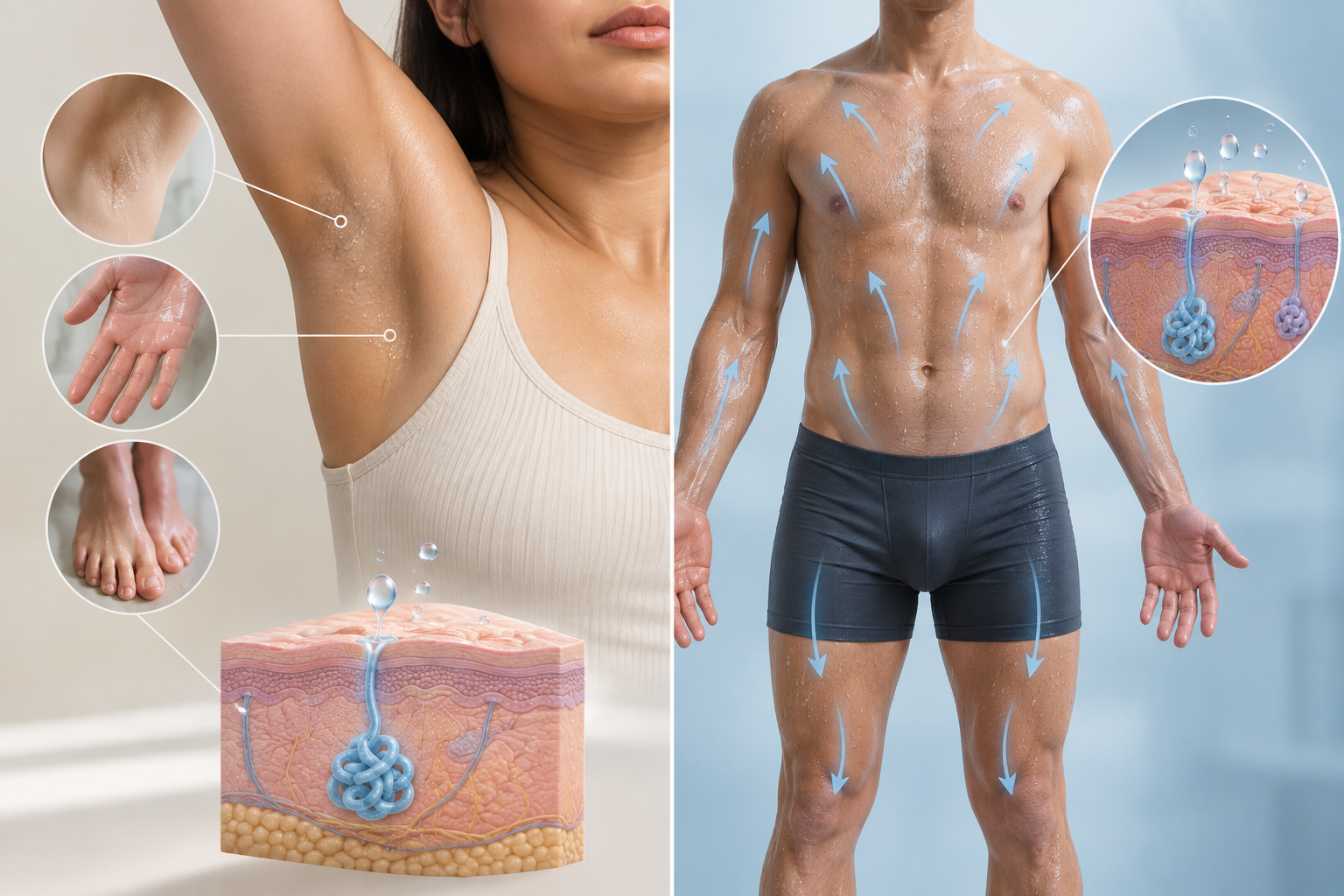
Here's a question worth pausing on before you treat heavy sweating: does it stay in one spot, or spread everywhere? That answer splits localized hyperhidrosis from the systemic kind, and each one asks for something completely different. Chase the wrong pattern and treatments miss. Get it right and the path forward opens up fast.
TLDR:
- Localized sweating hits specific spots like hands or underarms and usually stops during sleep.
- Systemic sweating covers the whole body, may persist at night, and sometimes points to a cause underneath.
- Warning signs of a systemic cause: onset after 25, one-sided sweating, and no family history.
- Focal sweating responds to targeted options like antiperspirants and gels; systemic needs the root cause found first.
- Twofold connects you with sweat-focused dermatologists who sort your pattern before prescribing; talk to a provider for personal advice.
What Sets Localized and Systemic Hyperhidrosis Apart
If you sweat far more than your body needs to cool itself, the first thing worth pinning down is where it happens.
Localized hyperhidrosis, also called focal, concentrates in specific spots: palms, soles, underarms, or the face. Systemic hyperhidrosis, also called generalized, spreads across the whole body at once.
That split matters because it points toward different causes and treatments. Localized sweating usually runs on its own, while whole-body sweating more often ties back to something internal. Figuring out which pattern fits you shapes everything that comes next.
| Feature | Localized (focal) | Systemic (generalized) |
|---|---|---|
| Where it happens | Specific spots: palms, soles, underarms, or face | Large areas or the whole body |
| Symmetry | Symmetric (both hands, both feet, both underarms) | Widespread, can be one-sided/asymmetric |
| During sleep | Usually eases off overnight | Persists day and night, including sleep |
| Typical onset | Often before age 25 | Can begin at any age |
| Usual cause | Primary (idiopathic), often runs in families | Secondary to a condition or medication |
| Treatment approach | Targeted, area-specific therapies | Find and treat the underlying cause first |
Localized Hyperhidrosis: What It Looks Like and Why It Happens
Localized hyperhidrosis is the more common type, and it follows a recognizable pattern. The sweating shows up symmetrically, hitting both hands, both feet, or both underarms instead of one side alone. Focal hyperhidrosis usually starts early, often before age 25, and quiets down while you sleep. The amount can feel out of proportion to what you're doing, soaking through a handshake or a pair of socks on an ordinary day. Because it stays put in defined zones, you can often predict exactly where it will flare, whether that's slippery palms before a meeting or damp underarms in a warm room. That consistency is part of what makes this type so recognizable, and it's also what gives treatment a clear target to aim at.
Most of the time this type is primary, meaning idiopathic with no illness behind it. It links back to an overactive sympathetic nervous system, the part that controls sweat signaling, and it often runs in families. Heat, stress, or spicy food can make it worse.
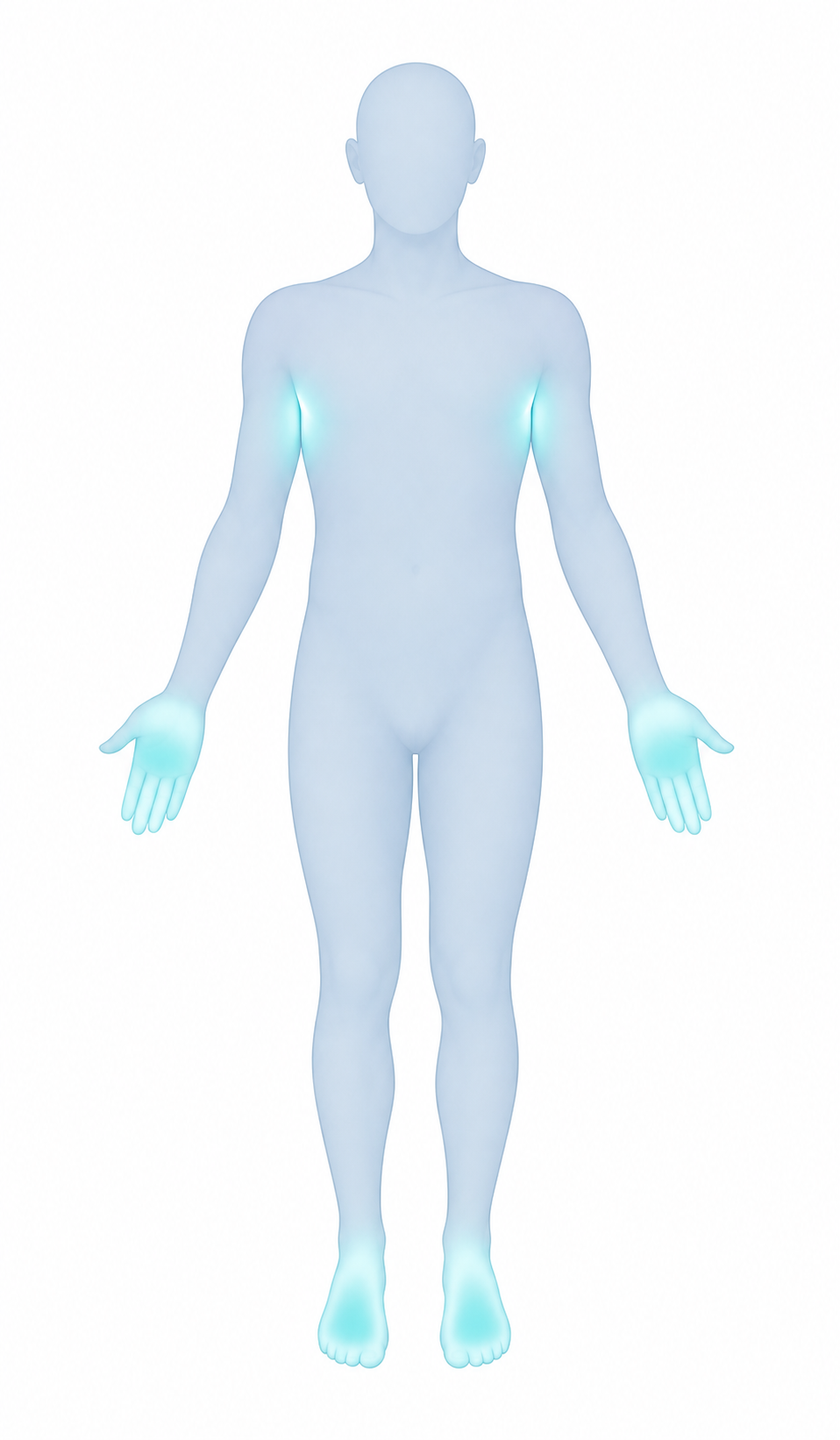
Systemic Hyperhidrosis: What It Looks Like and Why It Happens
Systemic hyperhidrosis works differently. The sweating covers large areas or the entire body, and it sticks around day and night, including while you sleep. That nighttime persistence is a key tell, since localized sweating usually eases off overnight.
This type is usually secondary, tracing back to an underlying condition or a medication instead of showing up on its own. It can begin at any age. Thyroid issues, diabetes, menopause, pregnancy, certain infections, and some antidepressants are common culprits.
So when sweating spreads across your whole body or wakes you at night, treat it as a prompt to look for a cause underneath.
The Root Causes Behind Each Type
The two types diverge at the root. Localized, primary sweating has no identifiable cause. The leading explanation is genetics paired with an overactive sympathetic nervous system, which is why it so often runs in families.
Systemic, secondary sweating typically traces back to something. Common triggers include:
- Thyroid disorders and diabetes
- Menopause and pregnancy
- Infections
- Neurologic conditions
- Certain medications, a common cause, including antidepressants like SSRIs and SNRIs
Sweating is a known side effect in as many as 1 in 10 people taking some drugs, so review your current prescriptions.
Warning Signs That Point to a Systemic Cause
Some patterns hint that your sweating is secondary to something else, and they're worth knowing. Watch for:
- Sweating that keeps going while you sleep
- One-sided or asymmetric sweating instead of matched areas
- Onset after age 25
- Whole-body instead of spot-specific sweating
- No family history of excessive sweating
Any of these deserve attention. Serious underlying causes exist, and no self-check can rule them out. If your pattern lines up with these signs, see a provider who can run the right workup and pin down what's actually driving your symptoms.
How Providers Tell the Two Apart
Diagnosis starts with conversation, not equipment. A provider reviews your history and where sweating lands, since distribution alone often separates focal from generalized.
A few tools help too. The starch-iodine test turns skin dark where sweat appears, mapping affected zones. Gravimetric testing weighs paper before and after to measure output. If a secondary cause seems likely, blood or imaging work rules out drivers like thyroid or blood sugar problems.
For primary hyperhidrosis, providers look for a cluster of recognized diagnostic criteria:
- Visible excessive sweating for six or more months
- Symmetric distribution
- Sweating that stops during sleep
- Family history
- Onset before age 25
Meeting several points toward localized sweating. Missing them nudges the workup toward a systemic cause.
Treating Localized Hyperhidrosis
Because localized sweating stays in defined spots, treatment can target those areas directly. Providers usually start mild and escalate only if needed.
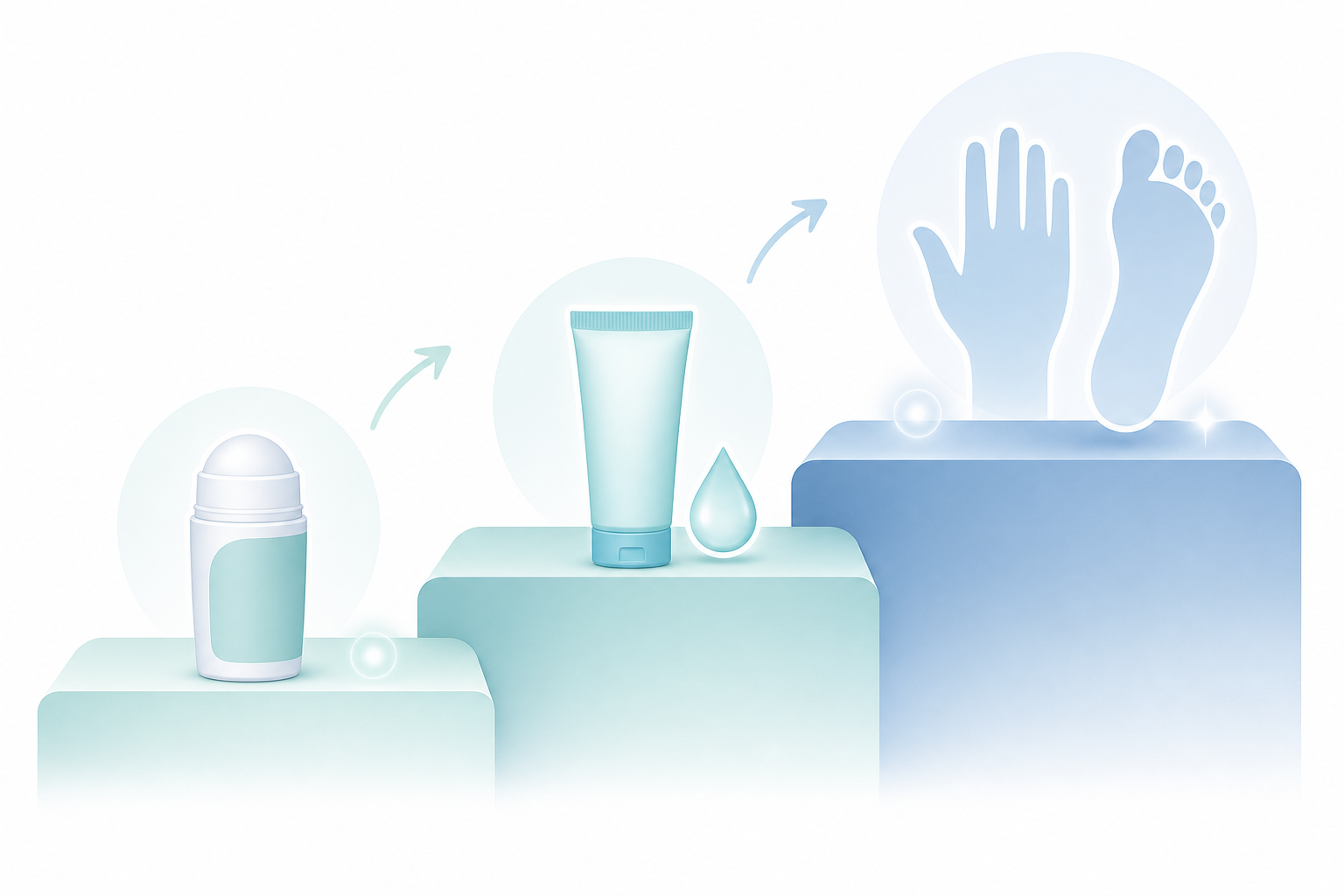
- Antiperspirants: aluminum-based, clinical-strength or prescription. First-line and non-invasive, though irritation is a common complaint. Some people also try natural treatments for hyperhidrosis alongside these options.
- Topical anticholinergics: gels and wipes that block the sweat signal at the skin, with minimal systemic exposure.
- Iontophoresis for hyperhidrosis: well-suited to palms and soles, but it needs repeated sessions.
- Botox for hyperhidrosis: injections for targeted zones, lasting months.
- Microwave thermolysis: a longer-lasting option for underarms only.
- Surgery: reserved for severe, treatment-resistant cases.
The takeaway? Focal sweating responds well to area-specific therapies.
Treating Systemic Hyperhidrosis
Systemic sweating calls for a wider lens. The first move is finding and treating any underlying condition or swapping out a medication that's driving it, since resolving the source can settle the sweating on its own.
When the goal is the sweating itself, whole-body coverage rules out any single topical zone. That's where oral anticholinergics like glycopyrrolate for hyperhidrosis come in, working across the body at once.
Keep in mind that secondary hyperhidrosis doesn't always clear fully, especially when the culprit is a medication you still need. In those cases, management focuses on easing symptoms while your provider weighs the trade-offs.
Why the Distinction Changes Your Treatment Path
Getting the type right is what makes a plan work. Classify sweating as localized, and the path opens with targeted options: antiperspirants, topical gels, then in-office procedures aimed at the exact spots that bother you. A broader look at reducing excessive sweating can help guide those steps. Classify it as systemic, and the first job becomes hunting down the underlying cause, with body-wide medication as a possibility once that's sorted.
Skip that step and treatments start to miss. A whole-body pattern chased with a single-zone gel leaves most of the sweating untouched. Focal sweating met with an oral pill invites body-wide side effects you never needed. So the distinction is about what each type actually requires, not what to call it.
Managing Hyperhidrosis From Home Through Telehealth
Seeing a provider once meant booking an in-person visit, and that hurdle keeps many people quiet about their symptoms for years. Sweat-focused telehealth changes that, offering a private way to get assessed and start treatment from home.
If you go this route, look for a few things:
- Licensed dermatologists reviewing your case, not a generic intake
- The ability to sort localized from systemic patterns before prescribing
- Clear, upfront pricing
- Ongoing follow-up so doses can be adjusted over time
It works well for straightforward focal sweating. Complex or clearly systemic cases may still need an in-person workup, and a good service will tell you so.
How Twofold Approaches Localized and Systemic Sweating
We built Twofold as a virtual sweat clinic connecting you with board-certified, sweat-specialized dermatologists. You complete an online intake, and a dermatologist reviews it within about 24 hours to sort out whether a localized or generalized pattern drives your sweating.
For focal sweating, the topical oxybutynin 8% gel can applied nightly to affected areas like hands, feet, underarms, or face. For systemic patterns, dermatologists may prescribe oral glycopyrrolate or extended-release oxybutynin, including combination plans.
Final Thoughts on Localized vs Systemic Hyperhidrosis
Knowing whether your sweating is localized or spread across your body changes what actually helps. One points to targeted care, the other to finding a cause underneath. Track your own pattern, then let a provider confirm it so you can move toward a plan built for you.
FAQ
How do you know if your sweating is localized or systemic hyperhidrosis?
Localized sweating shows up symmetrically in specific spots like both palms, soles, or underarms, usually starts before age 25, and eases off while you sleep. Systemic sweating covers large areas or the whole body, persists through the night, and can begin at any age, so nighttime sweating that wakes you is a signal to look for an underlying cause.
What are the best telehealth options for treating hyperhidrosis in 2026?
Look for a sweat-focused service where licensed dermatologists review your case, sort localized from systemic patterns before prescribing, and offer clear pricing plus ongoing follow-up for dose adjustments. Twofold fits this model by connecting you with board-certified, sweat-specialized dermatologists who review your intake within about 24 hours and can prescribe topical or oral options based on your pattern.
Can you treat systemic hyperhidrosis with a topical gel?
Usually not on its own, because whole-body sweating covers too much area for a single-zone topical to reach. Systemic cases start with finding and treating any underlying condition or medication, and when the sweating itself is the target, oral anticholinergics like glycopyrrolate or extended-release oxybutynin work across the body at once.
Should you use a topical gel or oral medication for hyperhidrosis?
Focal sweating responds to topical options; whole-body sweating usually calls for oral anticholinergics. A provider can confirm which fits your pattern.
What should you look for in an online hyperhidrosis clinic?
See the telehealth section above for the key criteria; Twofold fits this model with board-certified dermatologists and 24-hour intake review. A trustworthy service will also tell you when a complex or clearly systemic case needs an in-person workup instead.
If you see a mistake or something you think should be updated, let us know at hello@itstwofold.com!


