

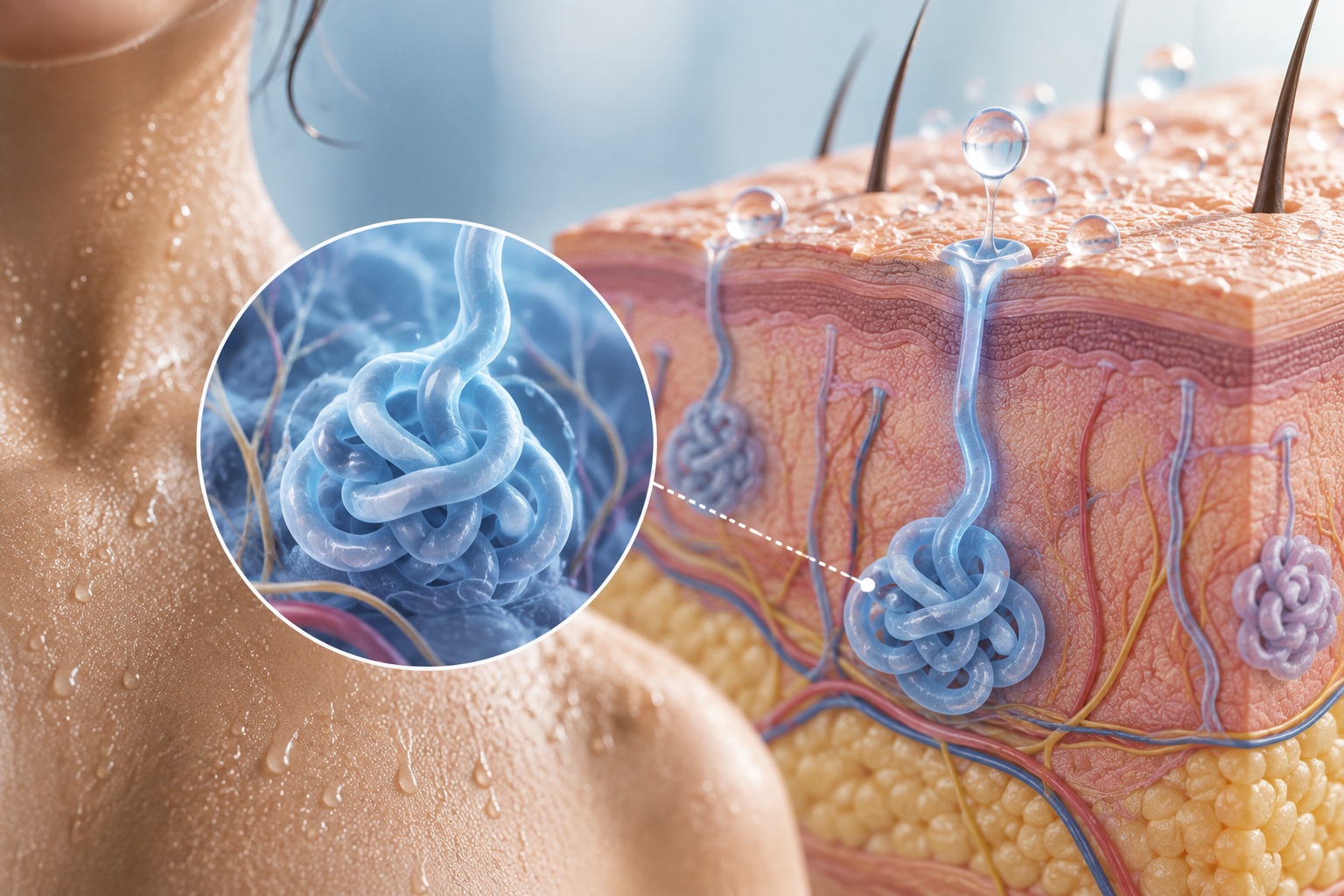
We all sweat, but for some of us it shows up when it makes no sense, like soaked palms in a cool room. Those are your eccrine sweat glands, the ones behind almost all your everyday sweating. When they overproduce, it usually comes down to overactive wiring, not faulty glands. Stick with us and we'll explain exactly how it works.
TLDR:
- Eccrine glands are your body's main sweat glands, cooling you as sweat evaporates off the skin.
- You carry 2 to 4 million of them, packed densest on palms and soles.
- In hyperhidrosis, the glands are normal; overactive nerves send too strong a signal to fire.
- Treatments like antiperspirants, anticholinergics, and Botox manage sweating but don't cure it.
- Twofold makes available compounded topical oxybutynin 8% gel and oral medications to quiet the acetylcholine signal to glands.
What Are Eccrine Sweat Glands?
Eccrine sweat glands are your body's main sweat glands, and they're behind almost all of the everyday sweating you notice. When your palms go damp before a big meeting or your shirt sticks to your back on a hot afternoon, that's eccrine glands at work.
Picture tiny coiled tubes tucked into your skin. They pull fluid from around your blood vessels, push it up through a duct, and release it onto the surface as sweat. That's the short version.
Over the next few sections, we'll walk through their anatomy, how they actually make sweat, and what goes wrong when they produce far more than your body needs.
Eccrine vs. Apocrine Sweat Glands
Your body runs two kinds of sweat glands, and they behave differently. Eccrine glands cover nearly your whole body and open straight onto the skin. Apocrine glands cluster in your armpits and groin, emptying into hair follicles instead, and axillary hyperhidrosis affects that underarm region.
Timing sets them apart too. Eccrine glands become active right after you're born, while apocrine glands stay quiet until puberty.
| Feature | Eccrine | Apocrine |
|---|---|---|
| Location | Almost everywhere | Armpits, groin |
| Opens onto | Skin surface | Hair follicles |
| Active from | Birth | Puberty |
| Odor | Odorless | Causes body odor |
Eccrine sweat has no smell. Apocrine secretion only turns into body odor once skin bacteria break it down.
How Many Eccrine Glands You Have and Where They Are
Most of us carry somewhere between 2 million and 4 million eccrine sweat glands, though the exact number varies from person to person. They cover nearly all of your skin, but not evenly.
The heaviest concentration sits on your palms and the soles of your feet, with 250 to 500 glands per square centimeter. That density is why sweaty hands and feet feel so noticeable.
A few areas skip them entirely, including the lips, the nail beds, and parts of the external genitalia.
The Parts of an Eccrine Sweat Gland
Each eccrine gland has two working parts. Deep in the dermis sits the secretory coil, a tightly wound tube that produces the sweat itself. Running up from it is the duct, the narrow channel carrying that fluid to your skin's surface.
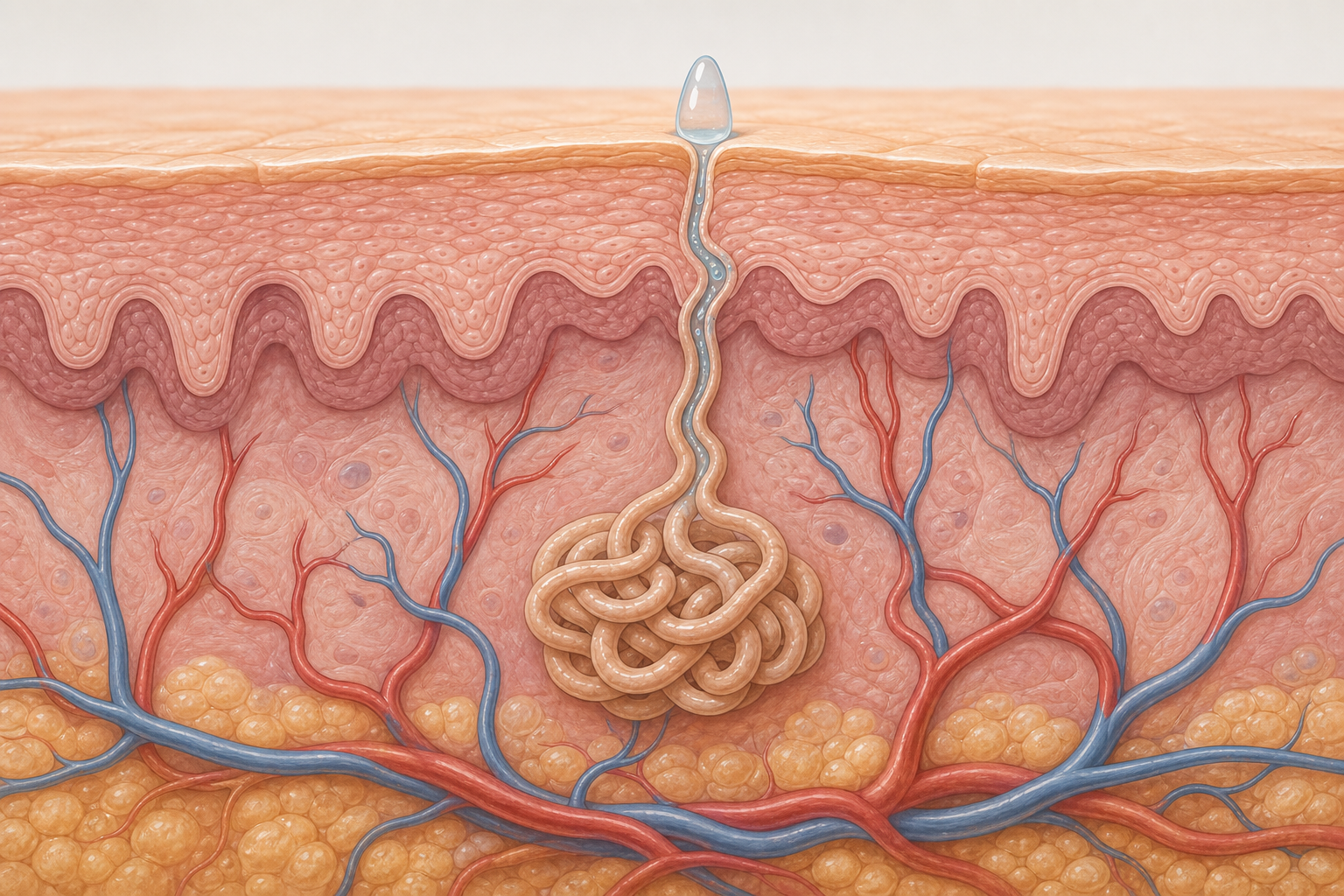
The coil is lined with two cell types. Clear cells release the watery part of sweat along with salt, while dark cells add other secretions. Wrapped around them are myoepithelial cells, which contract to push sweat upward.
As the fluid travels up the duct, some salt gets reabsorbed, so what reaches the surface ends up more dilute.
How Eccrine Glands Make Sweat and Cool the Body
Cooling is the main job here. When your core temperature rises, eccrine glands release watery sweat onto the skin, and as that moisture evaporates, it carries heat away and brings your temperature back down.
The trigger comes from your nervous system. Eccrine glands sit under the control of the sympathetic nervous system, and they fire when a chemical messenger called acetylcholine reaches them from nearby nerve endings.
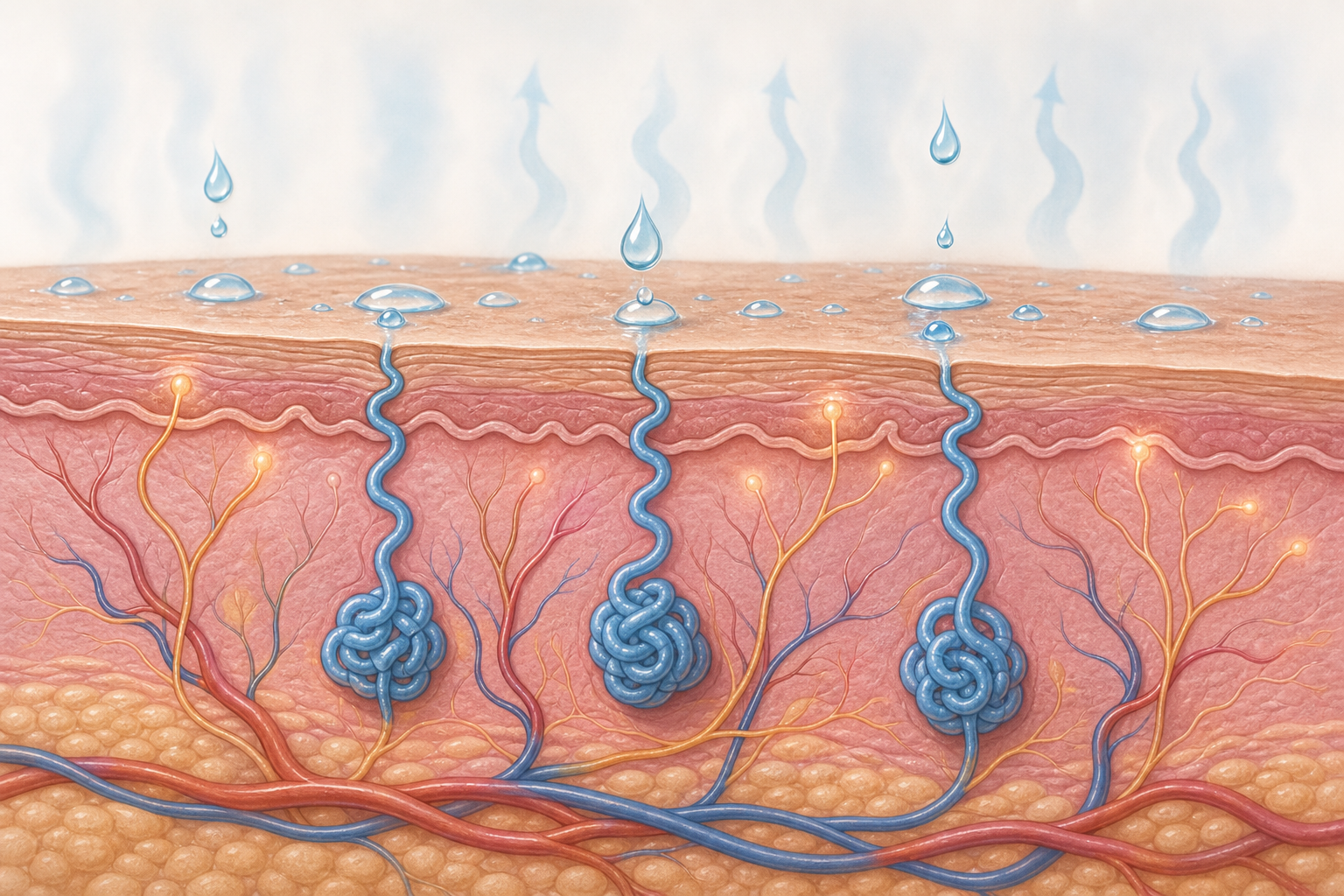
The volume adds up fast. In response to emotional or thermal stimuli, sweat glands can produce between 500 mL and 750 mL of sweat daily.
What Is in Eccrine Sweat
Eccrine sweat is mostly water, a hypotonic solution more diluted than your blood. It carries electrolytes like sodium and chloride, plus small amounts of waste such as urea.
Cooling gets most of the attention, but sweat quietly does more. Additional functions include keeping skin hydrated, secreting antimicrobial peptides that help balance your skin microbiome, and clearing waste products, including several drugs your body is flushing out.
So the fluid on your skin is doing a few jobs at once, even when it feels like nothing more than a nuisance.
Why Eccrine Glands Overproduce in Hyperhidrosis
Here's the thing worth sitting with: in hyperhidrosis, the eccrine glands themselves are usually perfectly normal. They aren't broken or oversized. The problem is upstream, in the nerves telling them when to fire.
Hyperhidrosis involves hyperactivity of the sympathetic nervous system, causing excessive release of acetylcholine from the nerve endings. It's also believed the negative feedback loop to the hypothalamus may be impaired, so the body keeps sweating past the point of cooling itself.
In other words, the wiring sends too strong a signal to healthy glands.
Because serious underlying causes can exist, it's worth seeing a provider to pin down what's driving your symptoms.
Common Conditions That Affect Eccrine Glands
Eccrine glands can misfire in more than one direction. Hyperhidrosis is the overproduction side, where glands release far more sweat than cooling calls for.
The opposite is anhidrosis, when glands produce too little sweat. That leaves the body unable to cool itself, raising the risk of overheating.
Blocked ducts cause their own trouble. Trapped sweat shows up as heat rash, those small itchy bumps you get in hot, humid weather.
Within hyperhidrosis, there's a useful split:
- Primary focal hyperhidrosis tends to hit focal spots like the palms, soles, underarms, and face.
- Secondary hyperhidrosis ties back to another condition or medication and can appear more widely.
Sorting one from the other takes a trained eye, so a provider is the right place to start.
Treatment Options for Overactive Eccrine Glands
No single option works for everyone, so treatment usually steps up in intensity until sweating is under control. Some people also try treating hyperhidrosis naturally before moving to prescription options.
- Clinical-strength antiperspirants: block ducts at the surface; cheap, but can irritate skin.
- Topical and oral anticholinergics: quiet the acetylcholine signal to glands; oxybutynin for hyperhidrosis is one commonly used option, though oral versions can bring dry mouth or blurred vision.
- Iontophoresis for hyperhidrosis: uses water and mild current for hands and feet; needs regular sessions.
- Botox for hyperhidrosis: pause sweating locally for months; requires repeat visits.
- Microwave thermolysis and surgery: target underarm glands more lastingly, though surgery can trigger compensatory sweating elsewhere.
All of these manage symptoms instead of curing them, and sweating returns if treatment stops. Talk to a provider before deciding what fits you.
How Twofold Helps Manage Overactive Eccrine Sweating
Since overproduction traces back to that acetylcholine signal, it makes sense to quiet the signal itself. That's the pathway anticholinergics work on, and topical oxybutynin for excessive sweating targets it directly at the application site. The flagship product available is a compounded oxybutynin gel at 8%, applied once nightly, that blocks acetylcholine's message to sweat glands right where you apply it.
Getting it works like this:
- A free online medical intake, reviewed by a sweat-specialized dermatologist within about 24 hours.
- Medication shipped in 2 to 5 business days.
- Unlimited dermatologist follow-up messaging, so you can adjust without an in-person visit.
A few things to keep in mind. Oxybutynin's use for hyperhidrosis is off-label, and because the gel is compounded, the product isn't separately FDA-approved. Most patients notice initial change in 1 to 2 weeks, with fuller results by around 4 weeks. Learn more about oxybutynin gel for sweating to understand what to expect. Results aren't permanent, and sweating returns if you stop.
Final Thoughts on What Your Eccrine Sweat Glands Do
Your eccrine glands cool you down, hydrate your skin, and mostly go unnoticed until they overdo it. When that happens, the fix is about calming the signal telling them to fire, and you have several ways to get there. Chat with a provider about your symptoms, and you can figure out what actually fits your day.
FAQ
What's a good telehealth option for treating overactive eccrine glands in 2026?
Twofold is a telehealth service built solely around hyperhidrosis, pairing you with sweat-specialized dermatologists who review your intake within about 24 hours and prescribe a compounded topical oxybutynin 8% gel. Because it focuses only on excessive sweating instead of general dermatology, care comes from providers who treat this condition day in and day out.
Can you treat overactive eccrine glands without in-person dermatologist visits?
Yes. Services like Twofold run entirely online, pairing you with a sweat-specialized dermatologist. See the "How Twofold Helps" section above for the full process.
Topical vs. oral anticholinergics for eccrine sweating, which should you use?
Both quiet the acetylcholine signal that tells eccrine glands to fire, but they work differently: topical oxybutynin acts right where you apply it with minimized systemic absorption, while oral versions treat the whole body and can bring dry mouth or blurred vision. A dermatologist can help decide, and some plans pair a lower oral dose with topical treatment on stubborn areas like the hands or feet.
Why do eccrine glands overproduce sweat in hyperhidrosis?
The glands themselves are normal; it's the nerves that are the issue. See the "Why Eccrine Glands Overproduce in Hyperhidrosis" section above for the full explanation.
How long does topical oxybutynin gel take to reduce eccrine sweating?
Most patients notice initial change in 1 to 2 weeks, with fuller results by around 4 weeks of nightly use. See the "How Twofold Helps" section above for more on what to expect.
If you see a mistake or something you think should be updated, let us know at hello@itstwofold.com!


